
Last week I attended an “ISIS in America” presentation. It was hosted by a local university for a law enforcement audience, but was open to the public. Making the event a free-for-all was a bad idea; a few people on personal crusades showed up just to pitch their causes. For example, at one point a woman stood up to tell the crowd, for no apparent reason, about her quest to change Texas textbooks.
The event organizer was a retired army officer turned college professor. Most of his talk was a litany of right-wing talking points, delivered to an extremely receptive audience. I found myself annoyed. I actually agreed with many of his comments, but like to think I have a deeper understanding of the reasoning behind them. His speech was more “We need to bomb ISIS!” followed by cheers, rather than in-depth explanations of how incredibly difficult this problem is to solve.
Then the first guest speaker arrived. He was an American Muslim who converted in the 1960s, now a professor of Muslim history. He gave a very interesting, insightful presentation about Islam’s history, and some of the factors that led to ISIS’s creation. He emphatically condemned ISIS, clearly stated the Muslim world needed to defeat ISIS, and joked “Islam would be perfect, except for Muslims.” He mentioned the recent execution of the Jordanian pilot and pointed out Islam does not condone burning prisoners.

I was very impressed with his speech. So were the people I was with. The police officers in the room stayed quiet. But, of course, someone had to make a show of challenging the professor.
A tall older man in a suit, apparently not a cop, stood and walked to the professor with a book in hand. He asked in a loud, bombastic voice, “Professor, are you familiar with this book? This is a biography of the Prophet Mohammed, written hundreds of years ago!”
The professor said he had heard of the book. The man asked, again in a loud voice, “Would you agree, professor, that this is an accurate representation of Mohammed’s life?”
The professor said he hadn’t read it.
The man announced, “Allow me to point out this passage!” And he told a story of Mohammed setting a fire on a Jewish prisoner’s chest to make him reveal where he’d hidden valuables.
The professor calmly explained that not all Muslims accept the biography as true, and that it’s not a source of religious law. He said that even if the story was true, that didn’t mean Islam condoned burning prisoners. The professor badly stepped on his crank at one point – “If Mohammed did that, he didn’t do it often,” which drew laughter from the audience – but he clearly explained that despite the biography’s claim, Islam does have rules governing treatment of prisoners.
After the grandstanding man finally sat back down, an elderly woman confronted the professor about Islam’s treatment of women and non-Muslims. The professor, of course, defended Islam’s racial inclusiveness. But he also admitted it has problems. “Islam does have a room for improvement when it comes to equality.”
The woman made a comment about crimes committed by radical Muslims. Then she turned to the audience and sneered, “The ‘religion of peace.’”
When the host shut down questions, another man actually put an “infidel” t-shirt on, over his long-sleeve button-down collared shirt, and tried to approach the professor. He didn’t get a chance, because someone else was already there asking why “all the different sects like Sunni, Shiites and Kurds” – not understanding Kurds aren’t a sect – “are killing each other.”
I listened with growing disgust. Yes, I despise radical Islam. I’d personally napalm every ISIS fighter if I could. And I’m agnostic, no fan of religion in general. But I’ve lived and worked with Muslims in Kosovo. I’ve fought beside Muslim soldiers in Afghanistan. I’ve helped a Muslim friend write a novel. I’ve taken a Muslim friend from Libya to the shooting range. Two months ago I attended a murder mystery party hosted by a friend originally from Lebanon; my wife and I mingled with white, black and Arab guests all dressed in 1920’s flapper and gangster costumes (and at any party hosted by an Arab, the food is awesome).

With two Afghan Army officers in Kapisa province, 2009. The soldier in green coveralls was thirty-five then, and had been fighting continuously since age fifteen. I went on many mission with him.
The Muslims I’ve known and served with had nothing in common with ISIS, despite the fact that they share the same religion. Just like my Christian parents have nothing in common with the Westboro Baptist Church. I can hate the WBC without hating all Christians. And I can hate radical Islam without hating all Muslims.
ISIS is in fact Islamic, as The Atlantic explained in a fantastic recent article (http://www.theatlantic.com/features/archive/2015/02/what-isis-really-wants/384980/). So were the Afghan troops I served beside. So were my Albanian friends in Kosovo. So are many of my American friends. ISIS wants a return to the caliphate of Mohammed’s time, and believe in following every Islamic law to the letter. The Muslims I’ve known have been, to say the least, different.
Many Afghan soldiers really liked American girly magazines, and alcohol. An Albanian friend in Kosovo explained, “Yeah, I’m Muslim and all that. But if you follow all the Muslim rules you can’t drink, can’t smoke, can’t have sex, can’t do anything. I’m not going to live like that.” A Muslim fellow police officer in Texas echoed that sentiment. “You know Catholics who go to church twice a year, on Christmas and Easter? That’s how Muslim I am.” A former Afghan translator I served with in Afghanistan, who now lives in Texas, is so incensed by ISIS’ acts in the name of his religion he wants to join the Peshmerga and kill them. I know Muslims who are devout and observant, and still have nothing in common with ISIS.
I might also mention that the Kurds, who are heroically resisting ISIS, are Muslim. So are the Muslim Jordanians. I’d venture to say Jordan’s King Abdullah commands more respect among soldiers and marines than our own president.


I can hate ISIS without hating all Muslims. I can acknowledge the blindingly obvious – ISIS is Islamic – without believing all Muslims are like them. While there is obviously something in Islam which convinces far too many of its followers they’re justified in committing the most inhuman acts imaginable, far larger numbers of Muslims reject ISIS’ actions.
We in the west often say the Muslim world needs to strongly condemn ISIS. Then we have Muslims who do condemn them, like the professor. And they’re willing to do so out loud, in public, to an audience of non-Muslims. They should be applauded for that. Instead, some are challenged and ridiculed by morons using their ignorance to prove a flawed point.
Plenty of Muslims are good guys. We’re fighting on the same side, against a common enemy. When Muslim good guys condemn Muslim bad guys, let them. Support them. Stand with them. Don’t insult and berate them, simply because you can’t tell the difference between good ones and bad ones.
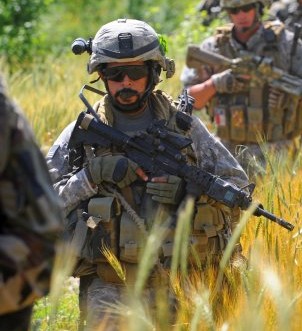
Chris Hernandez is a 20 year police officer, former Marine and currently serving National Guard soldier with over 25 years of military service. He is a combat veteran of Iraq and Afghanistan and also served 18 months as a United Nations police officer in Kosovo. He writes for BreachBangClear.com and Iron Mike magazine and has published two military fiction novels, Proof of Our Resolve and Line in the Valley, through Tactical16 Publishing. He can be reached at [email protected] or on his Facebook page (https://www.facebook.com/ProofofOurResolve).


 ]]>
]]>