
A few months ago, a woman sitting next to me on an airplane started a friendly conversation. When she found out I was an Iraq and Afghanistan veteran, she asked about something that was obviously bothering her.
“My daughter’s friend is an Iraq veteran,” she said. “He wasn’t in combat, but he’s disabled by PTSD. He was a medic, and he says the enemy was always trying to capture medics. On missions they wouldn’t let him out of the Humvee because he was in so much danger. He says his PTSD is from being scared of being captured.”
The woman was almost embarrassed to tell the story. Her expression betrayed obvious doubts about this veteran’s “trauma”. But like most of the public, she didn’t feel justified questioning any PTSD claim, from any veteran, for any reason. When I told her I never heard of medics being targeted more than anyone else (especially since they don’t dress or look different than other troops), that riding in a Humvee in Iraq isn’t so scary as to disable someone for life, and that he was probably milking the system for free money, she seemed relieved. She suspected the same thing, but didn’t feel right saying so.
It’s fair to say most of us combat veterans have suspicions about PTSD claims. We’ve been frustrated by stories of horrible, disabling PTSD from people we know were never in combat. We’ve heard of troops coming home from deployments to peaceful countries, never hearing a shot fired, but immediately claiming PTSD. We know that in the War on Terror only a small percentage of troops actually faced an enemy, and many of those relished the experience. We have the nagging feeling most PTSD claims are more about free money than healing and recovery. Some of us have become so skeptical, we automatically throw a mental BS flag when we hear someone talk about having PTSD.
But most of us doubters aren’t psychologists. We’re not trained. We don’t know what transpires between a veteran claiming PTSD and his VA counselor. We know PTSD doesn’t require combat experience, and understand not everyone has the same resistance to trauma, but still wonder if veterans really get disability payments for being yelled at in basic training. We hear assurances that PTSD disability isn’t handed out like candy, that claimed trauma is investigated rather than blindly accepted, and that the “tiny number” of scammers are quickly identified and booted from the system. Maybe our suspicion that the VA PTSD system is corrupt and overrun with liars, scammers and thieves is off base.
If our suspicions were confirmed, that would be pretty depressing. Know what would be even more depressing? Being told by two VA psychologists that the system is even more corrupt and full of liars, scammers and thieves than we thought.
Not long ago I wrote an article about two “combat” vets and their attempts to paint veterans as pitiful victims of PTSD. A VA psychologist read the article and contacted me. He can’t speak publicly because he still works at a large VA center, but I verified his identity and work. I’ll call him John.
John has treated over 700 veterans for PTSD. He estimates 75% of his patients are either outright fabricating trauma, or twisting benign experiences into supposed trauma in order to qualify for disability benefits. “Of all patients referred to me in 2015 for PTSD evaluation, 25% (estimated generously) had a real trauma-related condition,” John wrote. “And the majority of the remainder were obviously feigning PTSD symptoms.”
Few of John’s patients were actual combat veterans. “Only 10% had documentation (CIB/CAB/CAR/Purple Heart/Bronze Star, etc.) indicating substantial combat exposure,” John said. “Yet just over half were receiving VA disability payments for PTSD. All who weren’t yet on disability for PTSD were applying for it, and most on disability were appealing to increase their disability rating.”
Read the rest at BreachBangClear.com.

Chris Hernandez is a 20 year police officer, former Marine and currently serving National Guard soldier with over 25 years of military service. He is a combat veteran of Iraq and Afghanistan and also served 18 months as a United Nations police officer in Kosovo. He writes for BreachBangClear.com and Iron Mike magazine and has published three military fiction novels, Proof of Our Resolve, Line in the Valley and Safe From the War through Tactical16 Publishing. He can be reached at [email protected] or on his Facebook page (https://www.facebook.com/ProofofOurResolve).

 ]]>
]]>Chris
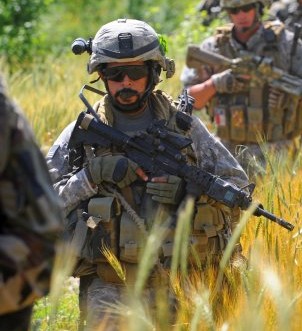
Chris Hernandez is a 20 year police officer, former Marine and currently serving National Guard soldier with over 25 years of military service. He is a combat veteran of Iraq and Afghanistan and also served 18 months as a United Nations police officer in Kosovo. He writes for BreachBangClear.com and has published two military fiction novels, Proof of Our Resolve and Line in the Valley, through Tactical16 Publishing. He can be reached at [email protected] or on his Facebook page (https://www.facebook.com/ProofofOurResolve).

 ]]>
]]>————————————
Signs, Of Veteran Entitlement
I won’t go into too much detail, since I’m sure most of you have heard of this already. But apparently some veterans are so traumatized by their wartime service they’re asking people to “be courteous with fireworks” around their homes on July 4th. Because fireworks “trigger” their PTSD.
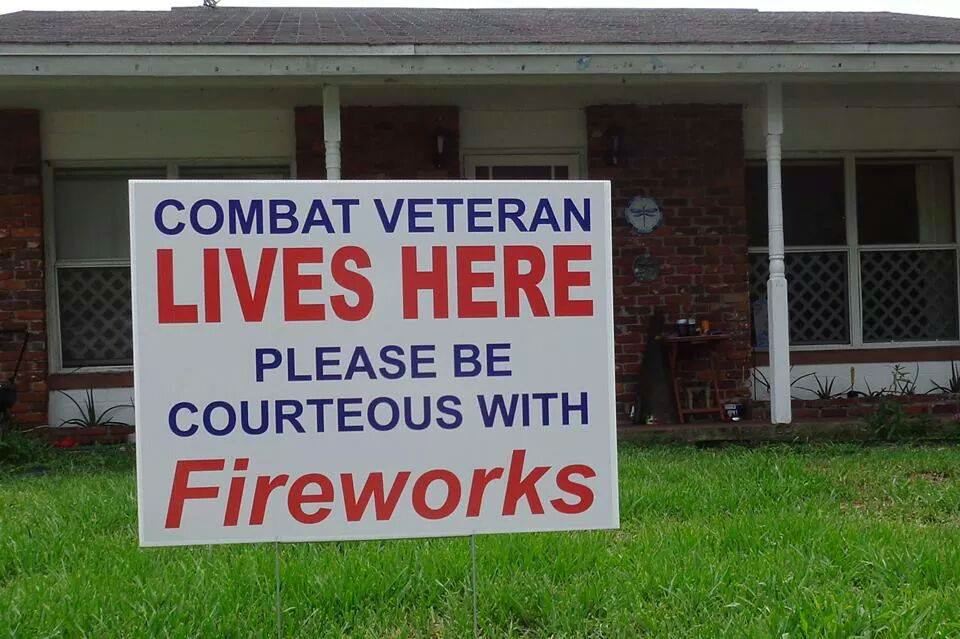
These signs are being popularized by an organization called “Military with PTSD”, which according to CNN has sent the signs to 2500 veterans and has 3000 more on a waiting list. According to the organization’s founder, the signs aren’t intended to make people stop using fireworks, they’re just asking people to be “courteous”. “No veteran that served the United States wants to take a freedom away from people, especially fireworks, which represent freedom,” she said. “They don’t want them to stop. What they’re asking for is for people to give them a heads up.”
IT’S THE FOURTH OF JULY. Isn’t that heads up enough? Are these signs about “helping vets with PTSD”, or catering to some veterans’ sense of entitlement?
As a combat vet myself, I’ve had – to say the least – a strong reaction to these signs. My gut feeling was something along the lines of, “This is ridiculous. These signs don’t have anything to do with treating PTSD, they’re just a way for some veterans to beg for attention and be special snowflakes.” But I try to be fair, and realize my experiences have given me significant biases. So I tried to rationally analyze the pros and cons of putting those signs in veterans’ yards.
And after careful consideration, I can only conclude that these signs are pathetic, self-defeating crap.
John Adams wrote in 1776 that the Declaration of Independence ought to be celebrated with fireworks. I haven’t found a record of fireworks being used to celebrate in 1776; however, we’ve celebrated with fireworks since literally the first Independence Day commemoration in 1777. We did it while we were at war for our very existence, yet the men who survived massed musket fire and bayonet charges managed to endure fireworks displays without putting “pleafe be ye courteouf with ye olde firework” signs in their front yards.
It goes without saying, or at least it should, that past generations of American warriors experienced combat far worse than that of the typical Iraq or Afghanistan veteran. Yes, today’s warriors have fought some hard fights (Fallujah, Najaf and Sangin come to mind). But in terms of scale, casualties and intensity our wars have been different than many before. We haven’t endured three or four thousand KIAs in a single day like at Normandy and Antietam, or two thousand in 76 hours as at Tarawa. Yet the men who crossed sabers on Civil War battlefields or waded through surf, blood and dead comrades to a beach swept with machinegun bullets and shellfire somehow endured fireworks displays without putting signs in their yards.
What makes veterans of today’s wars different?
We’re not draftees. We’re volunteers. Anyone who enlisted or reenlisted after 9/11 volunteered for military service while our nation was at war. We went to war because of the choices we made, and many of us went back to war because of those same choices. Some veterans consider that wartime service an honor and privilege; the more intense the combat, the greater the honor and privilege.
And we see a growing divide not just between veterans and civilians, but between distinct groups of veterans. Some feel our service made us stronger and more resilient; others see themselves as damaged, and want everyone to know they’re damaged. At least 5500 of them want to advertise their problems to their neighbors, and some of those posted their photos on the internet to share their problems with the world. The cognitive dissonance displayed in some of those photos is astounding; maybe it’s just me, but I see a slight contradiction between someone saying they’re a hardened combat vet yet are uncomfortable with fireworks.

The next photo is almost perfect. What’s better than advertising “I’m a combat vet with PTSD, I’m armed and I might react irrationally to fireworks”? The only way to improve it is to add a bottle of whiskey, to achieve the “drunken vet with PTSD and a gun” trifecta.

I have to ask, what do these “combat veterans” expect to actually accomplish with these signs? At best, their close neighbors might see the signs and refrain from using fireworks. But what about the neighbors one street over? What about the people who live ten houses down, never drive past the combat vet’s house and have no idea he’s sensitive to fireworks? Some fireworks can be seen and heard from literally miles away; is the sign going to somehow protect the veteran from fireworks in other neighborhoods?
——————————–
Read the rest at http://www.breachbangclear.com/signs-of-veteran-entitlement/
Chris Hernandez is a 20 year police officer, former Marine and currently serving National Guard soldier with over 25 years of military service. He is a combat veteran of Iraq and Afghanistan and also served 18 months as a United Nations police officer in Kosovo. He writes for BreachBangClear.com and Iron Mike magazine and has published two military fiction novels, Proof of Our Resolve and Line in the Valley, through Tactical16 Publishing. He can be reached at [email protected] or on his Facebook page (https://www.facebook.com/ProofofOurResolve).
http://www.amazon.com/Line-Valley-Chris-Hernandez-ebook/dp/B00HW1MA2G/ref=pd_sim_kstore_1?ie=UTF8&refRID=09XSSHABSWPC3FM8K6P4
http://www.amazon.com/Proof-Our-Resolve-Chris-Hernandez-ebook/dp/B0099XMR1E/ref=pd_sim_kstore_1?ie=UTF8&refRID=0S6AGHBTJZ6JH99D56X7

 ]]>
]]>
USA Today photo
I wish people would stop assuming combat-related PTSD every time some veteran commits a violent crime. Veterans are representative of the country they serve; some are sterling citizens, some are rotten bags of snail crap. I personally am not aware of a single active shooter who had combat-related PTSD.
Cho, the Virginia Tech murderer, never served in the military.
The Sikh Temple murderer was a peacetime Army vet.
James Huberty from the San Ysidro McDonald’s was never military.
George Hennard at Luby’s was a former Merchant Marine who never saw combat.
The Columbine shooters were high school kids.
The Sandy Hook shooter was never military.
Hassan from the 2009 Fort Hood shooting never served in combat.
The Gabrielle Giffords shooter was never military.
James Holmes from the Aurora theater was never military.
Charles Whitman from the UT Tower shooting was a Marine who never saw combat.
Aaron Alexis from the Washington Navy Yard was a Navy veteran who never saw combat.
Ivan Lopez, Yesterday’s Fort Hood shooter, apparently never served in combat. Even if he had, that wouldn’t make him murder innocent people.
I can’t stress this enough. Lopez murdered people because he was a murderer, not because he was a combat vet. He wasn’t a combat vet. He didn’t murder because he had PTSD. He hadn’t even been diagnosed with PTSD. There’s no indication thus far that he experienced trauma during his deployment. He was just a murderer. People need to stop excusing his actions, and stop seeing him as something he wasn’t.
RIP to those we lost yesterday. Best wishes to the wounded and all family members affected by this brutal, senseless crime.
http://www.amazon.com/Line-Valley-Chris-Hernandez-ebook/dp/B00HW1MA2G/ref=cm_cr_pr_product_top
http://www.amazon.com/Proof-Our-Resolve-Chris-Hernandez-ebook/dp/B0099XMR1E/ref=cm_cr_pr_product_top

 ]]>
]]>
A few weeks back I wrote this essay for BreachBangClear.
http://www.breachbangclear.com/site/10-blog/632-ptsd-fakers-and-frauds-and-wtaf.html
In the essay, I discussed something that seems pretty obvious to me and a lot of other vets: many veterans are using fake PTSD claims to milk the system for a free monthly handout. That makes it harder for veterans with legitimate problems to get help. The essay generated plenty of intelligent responses in agreement or disagreement, a few “what the hell is he talking about” comments, and a good number of pretty funny personal insults. So I wrote a follow up essay, to address the response. BreachBangClear published it on February 26th.
“Not surprisingly, my essay PTSD: fakers and frauds and WTAF? generated hundreds of comments from angry, supportive, incredulous or head-nodding-in-agreement readers. Many veterans shared anecdotal evidence of other servicemembers who claimed PTSD for what appeared to be trivial things (for example, seeing a destroyed vehicle from a car bomb attack that happened a week earlier, or hearing a report of a possible sniper while on a convoy). In fact, if I recall correctly, of the many readers who agreed with me, only three weren’t veterans.
Of course, many people took exception to what I wrote. Quite a few thought my essay was insulting to non-combat troops. Some readers took my post to mean I don’t believe “fobbits” (a term I didn’t use in my essay) can get PTSD, or that people with PTSD shouldn’t get help. I objectively did not write those things, but the tone of my post apparently conveyed those messages to certain people.
One extremely angry reader commented, “What he said, and what people are hearing are two different things.” Well, a lot of people heard things very different from what I said. One reader, for no apparent reason, thought I claimed to be Special Forces and commented “Even regular Joe’s get PTSD too, not just you special forces assholes”. I got the distinct impression many readers skimmed through the essay, picked out whatever pissed them off the most, then furiously typed scathing comments. Those comments often seemed to have little connection to what I actually wrote.”
Read the rest at http://www.breachbangclear.com/site/10-blog/656-ptsd,-jackassery,-heroism,-integrity,-courage-strength.html

 ]]>
]]>———————————————————————–

Staff Sergeant David Moore, standing third from right. I’m kneeling at far right.
A couple of months ago I was watching Fox News and a preview for an upcoming story came on. The story was about a veteran with PTSD who had been prescribed a “PTSD dog”. The preview showed the back of the veteran’s head and showed him petting his dog as he drove his truck. The veteran’s southern drawl was evident, but his face was never shown.
I’m a veteran of Iraq and Afghanistan, and am well aware of the PTSD problem among some veterans. Unfortunately, I’m also well aware of the legion of liars and fakers pretending to have PTSD in order to get a monthly government handout. When I saw the preview, my first feeling wasn’t sympathy or concern. It was, Yeah, this guy has PTSD. I bet a rocket landed two miles away when he was on a huge base, and since then he’s been making up symptoms so he can get a disability check. Sure, whatever.
A few minutes later they showed the full story (which is here, if you’re interested). When I saw the veteran, I was stunned. It was Staff Sergeant David Moore, a Georgia National Guard soldier I was with on many missions with in Afghanistan.

David Moore and his PTSD dog Wilco.
Read the rest at http://www.breachbangclear.com/site/10-blog/632-ptsd-fakers-and-frauds-and-wtaf.html
http://www.amazon.com/Line-Valley-Chris-Hernandez-ebook/dp/B00HW1MA2G/ref=cm_cr_pr_product_top
http://www.amazon.com/Proof-Our-Resolve-Chris-Hernandez-ebook/dp/B0099XMR1E/ref=pd_sim_kstore_1

 ]]>
]]>http://ironmikemag.com/face-to-face-with-a-hero-71-years-after-his-death/
——————————————————————————

Leo Moreno, one of the “Battling Bastards of Bataan”
I recently received photos of a man I have always had tremendous respect for. I heard his name many times as a young child. I sometimes felt family members grow uncomfortable when I prodded them for details about his life, and once found a newspaper clipping about him buried in a drawer in my grandmother’s house.
Like me, he was a National Guardsman who went to war. Like me, he was short and slightly built. He was a handsome guy who probably didn’t lack female attention. He was my grandmother’s older brother, the uncle my father never met. His name was Leo Moreno.
Leo was a radioman on a B-17 in the California National Guard. In 1941 he was called to active duty and sent to the Philippines. On December 8th 1941, almost every Army Air Corps aircraft in the Philippines was destroyed on the ground by Japanese air attacks. Leo fought as a rifleman until the remaining American force, nearly out of ammunition and debilitated by losses, surrendered. Leo participated in the infamous “Bataan Death March”.
Other soldiers saw Leo on the March, but he never made it to a camp. The 1942 newspaper clipping I found in my grandmother’s house proclaimed Leo was “Missing, Presumed Dead.” Several years later his status was changed to “Killed in Action”. Like many other Americans lost in the Philippines, his remains were never recovered.
I remember listening in fascination to conversations among my grandparents and great uncles about Leo. He wasn’t the only member of his family to serve in World War II; all his brothers except one were in the military. My grandfather served in the Navy stateside, and his brother jumped with the 82nd at Sicily, Normandy and Holland. Leo’s youngest brother would later join the Marines, make the Inchon landing and fight at Chosin in Korea.
Service to our country in war just seemed to have been an accepted fact of life for my grandparents’ generation. I don’t remember ever hearing anyone complain about having served. And while my family grieved over Leo’s death, I never felt like they resented it.
We don’t have an official Army photo of Leo. But Leo had been an elevator operator in California and had a photo in his work uniform. My great-grandfather had that photo retouched to make it look like a military photo. A few days ago I finally got a copy of the retouched photo, which I consider a family treasure.

I also received something else that day: a picture of the “Citation of Honor” the Army sent after Leo was declared dead, signed by General “Hap” Arnold.

“He lived to bear his country’s arms. He died to save its honor. He was a soldier. . . and he knew a soldier’s duty. His sacrifice will help to keep aglow the flaming torch that lights our lives. . . that millions yet unborn may know the priceless joy of liberty.”
Those words mean something. They aren’t just ink on paper.
Lately I’ve been pretty outspoken about some things. I wrote three angry essays about Air Force Afghanistan veteran Lauren Kay Johnson and her list of petty complaints. I wrote about my disgust with servicemen and women who have a mild experience at war yet come home demanding money for alleged PTSD. I wrote an essay on Dillard Johnson, a man who exaggerated his wartime exploits to an unbelievably stupid level and managed to get a book contract out of it. I haven’t yet written about Brandon Bryant, the former drone operator who has complained about the “horrors” of his service by saying things like “Yeah, it’s not the same as being on the ground. So f**ing what?” and “I didn’t join the military to kill people.”
I look at those veterans, and read what they have to say. Then I look at my great uncle Leo, and other family members of that generation. I think of all the complaints they never made. And I feel that Leo’s willingness to sacrifice, to serve selflessly, is lacking in far too many of my generation’s veterans.
Leo represents true heroism to me. He wasn’t the Special Forces superman with decades of training, nor the Navy SEAL with countless confirmed kills. He’s the regular Joe, the ordinary man in extraordinary circumstances. The man who comes from normal life and endures pain and privation for the good of his country, with the expectation of returning to normal life afterward. The kind of man who feels honored by the opportunity to serve, instead of broadcasting to the world that he’s somehow been victimized.
I don’t know any details of my uncle Leo’s death. With so few survivors left, and after so many years, I doubt I’ll ever find out. I’ve read several books about the Bataan Death March, and I know some of the possible ways he died. He may have been shot or bayoneted for leaving the road to drink dirty water from a ditch. He may have simply dropped dead from dysentery, wounds and exhaustion. I like to think he died trying to escape into the jungle and carry on the fight, like many other Americans did. I’ve even joked that he’s probably still living in a Philippine jungle, being fanned with palm fronds by all of his wives and fed coconuts by dozens of children and grandchildren.
But I’ll never know for certain. And that’s okay. What I don’t know about Leo’s death isn’t as important as what I do know about his life.
When I look back across 71 years and see my great uncle Leo smiling in a bar with drink in hand, or posing with a serious look in his not-quite-military uniform, I see much of what made this country great. I see someone willing to give up his peace and youth so my children can enjoy theirs. I see someone who believes what we have in this country is worth fighting for, and dying for.
And I hope when he looks back at me from that photo, he sees the same things.
UPDATE 11-3-2013:
I just received a few more pictures from my sister. One is of Uncle Leo, the others are his brothers who also served. I don’t know exactly when or where these were taken.
Leo Moreno, MIA/KIA on the Bataan Death March.

His brother Dave Moreno. My uncle Dave served in the Army Air Corps in Ireland and married an Irish woman. Dave retired from the US Post Office and died several years back. He was a very good, decent family man and I have fond memories of him.

My uncle Paul Moreno, the oldest brother. He died when I was a pre-teen and I didn’t know him well. But I do remember seeing him at a family Christmas reunion, while he was dying of cancer. Someone commented that they were surprised to see him, and he replied with a smile, “I’m not gone just yet.” Later I saw him take his glasses off, wipe tears from his eyes and then try to act like he was okay. I visited his home many times near the end of his life, and it was hard to watch what cancer did to him. His wife, who seemed to adore him, died of cancer shortly afterward.

Tell me this isn’t super cool. Apparently Paul worked on P-38s. My great uncle helped keep some of the coolest airplanes EVER in the fight.

My uncle Richard Moreno, Korea Marine and one of the “Chosin Few”. Richard ran an amusement company after he got out of the Corps, and died way too young. He would only give the barest details of his service, so I never got the full story. I know he came home extremely traumatized, but eventually got past it. I knew him as a solid family man. His son was also a Marine.

One reader above commented that I “come from good stock”. I think he’s right. The relatives I’ve written about were first generation Americans who survived the Depression, then served in World War II, then came home to careers and families. They didn’t expect to be rich and didn’t search for ways to scam money from the government.
As a child I didn’t realize how much of an impression those men made on me. Now, as an adult, I’m thankful for every moment I spent around them.

Available in print and as an ebook from Amazon.com and Tactical16.com. Available electronically from iTunes/iBooks and Barnesandnoble.com.

 ]]>
]]>
This is the third post I’ve written in response to Lauren Kay Johnson’s Glamour Magazine essay about her struggle to adjust after Afghanistan.
https://chrishernandezauthor.com/2013/10/07/veterans-defeating-ourselves-with-the-medias-help/
https://chrishernandezauthor.com/2013/10/10/update-on-lauren-kay-johnson-af-veteran/
For reasons which I think are obvious, Johnson’s essay had a far larger impact than she expected. And rightfully so; she unintentionally illustrated a stark contrast inside our military. This isn’t the traditional “us and them” split between combat and support troops. It’s at a deeper, more elemental level.
In my last post about Johnson I asked if she is receiving disability payments for Chronic Adjustment Disorder. Johnson’s fiance contacted me after my first post on this subject, but I’ve heard nothing since I asked this question. That silence is probably an answer in itself.
As I said previously, if Johnson is receiving disability after never being in combat, and now suffers from a loss of interest in such things as potluck dinners and karaoke, then in my opinion she should be ashamed. That doesn’t mean I don’t respect her service, and don’t wish her well. It means I don’t think anyone should accept money for not experiencing trauma, and having minor adjustment issues after a deployment.
Many veterans, especially combat arms veterans, tend to agree with me. But others vehemently disagree. Some have expressed anger at the fact that I question Johnson’s disability assessment.
Two people who identified themselves as members of the Air Force made these comments on Reddit:
“She is disabled. Just because it doesn’t affect her on a daily basis doesn’t mean it wasn’t there. If she received the rating from the VA, she deserves the pittance paycheck.”
“There are so many things wrong with this [my blog post]. Is there now a certain level of horror that has to be met before a veteran can be treated and compensated for problems stemming from their service?”
I’ve seen similar comments from other vets, and especially from civilians. Perhaps they believe all veterans’ claims should be taken at face value; if a veteran says they have PTSD, they have PTSD. To question their claims is to insult all veterans.
I had a similar experience when I attended an EMT course several years ago. By policy, if a patient said they were having an emergency, it was an emergency. Even if it was, as on one call, “My scalp really itches, so I need an ambulance ride to the hospital.” As a cop accustomed to false claims, those blatantly ridiculous 911 calls grated on me. But as an EMT student, I had to shut my mouth and accept them.
Now, as a combat vet, I’m in the same situation. I hear constant stories of veterans with PTSD, including Johnson. If I call nonsense on any of them, I’m being insensitive to suffering veterans.
Here’s the problem: unfortunately, I know what kind of “trauma” many of these veterans experienced. In Iraq my mission was escorting convoys, which could be extremely dangerous and nerve-wracking. However, I lived on Tallil, a huge air base with a big PX, coffee shop, Pizza Hut and Burger King. Some of us had wireless internet. We had a large Morale, Welfare and Recreation building with movies, video games, books, billiards and free phone calls home. And while I was there, we never took a rocket or mortar hit. Tallil at that time was, as one soldier described it, a resort.
In Afghanistan on my second deployment I marveled at the contrast between the war in the countryside and the circus atmosphere at Bagram. Bagram took regular incoming, but the place was huge. Most troops were never affected by those rockets. One day one of my soldiers and I arrived at Bagram to find a party and DJ playing music at the “Bagram Marathon” finish line. My soldier shook his head, laughed and said, “There is no war here.” Yet if a soldier who never left the wire at Tallil or Bagram claims PTSD, I’m not supposed to question it.
Actual combat definitely leaves a mark. Constant anticipation of danger can do the same thing. But never being in combat (as Johnson admits in her blog) and living on a relatively safe base somehow also produces debilitating trauma?
Johnson’s essay shows the dramatic difference in mentality between those who joined the military specifically to endure the privations of combat, and those who seem to view war as an anomaly of military service. I know many of the former. They wanted combat, they accepted the pain that comes with it, their self-worth came from their ability to function under fire. They are what I call “the military within the military”. The latter, however, are built differently. They seem to feel that if they suffered in any way – and I mean ANY way – they’re entitled to a lifetime of compensation for it.
Consider Johnson’s list of “hardships” and “effects”. Dry meat, soggy vegetables, vulgar talk, knowledge that “something bad” could happen at any time. A loss of interest in potluck dinners and karaoke. The fact that Johnson voluntarily submitted her essay to Glamour as a “triumph over adversity” story is telling. At the conclusion of her essay she says, “But I know that being unsettled is OK. I know that I’m OK.” And many of us ask, “Unsettled from what? OK after suffering what?”
I know a man whose humvee was blown in half by an IED that killed two of his friends and nearly killed him. One of my soldiers had to dig the remains of six dead friends from a destroyed vehicle. Another friend called in an air strike on a house occupied by a handful of insurgents; after the strike, he discovered to his horror that it had also been occupied by over a dozen innocent civilians.
Two of these men are still in the military and leading successful, productive lives. The third would still be a soldier if he wasn’t crippled by his injuries. Yet I also know a soldier who has never deployed, openly states she could never fire a weapon at a person and can’t even handle combat training exercises because they cause her to have panic attacks.
I sit in the middle of this divide between warriors and, for lack of a better term, others. I’ve never been in the regular military, yet have been to war twice. I’ve held two combat arms specialties, yet gained most of my combat experience as a support soldier working with line troops. I’ve been in units where “suck it up and drive on” was the norm and a unit where a first sergeant declared “If you’ve been deployed and say you don’t have PTSD, you’re a liar.”
I know both extremes. And I’ve reached some conclusions.
Our country has been defended by generations of men and many notable women who went to war knowing it would be horrible. They didn’t expect a lifetime of sympathy simply for having been there. They would have been ashamed to proclaim to the world that they were never in combat yet receive disability payments for trauma. They wouldn’t have considered the normal aggravations of military service to be cause for complaint or compensation.
The spiritual descendants of those men and women fill our infantry, armor and artillery units. Many also serve vital support roles while bristling at the lack of warrior spirit around them. In America’s past crises and our current War on Terror those true warriors have risen, willingly embraced war’s challenges and placed themselves between us and danger. If they returned unscathed they carried on normal life, more likely to brush off any lingering effects of war than to ask for financial or psychological help.
If the country respects us veterans, it’s for our selfless service. Words like honor and sacrifice are imaginary constructs for most people. For us, they’re real. We joined the military for the stated purpose of serving our nation, not being served by it.
America doesn’t owe us a lifetime of comfort for doing what we volunteered to do. Yes, we deserve fair pay and benefits for our willingness to place ourselves between our people and their enemy. Anything above that, like the GI Bill, is an extra that we should be extremely grateful for.
That doesn’t mean we’re not owed anything. We’re owed, to a degree, respect for what we’ve done. And we get that respect. We get it when we fly back from Iraq and land in Maine at 3 a.m. to find dozens of well-wishers waiting inside the terminal. We get respect when we’re granted leave from Afghanistan, fly to Dallas on a chartered military flight and receive a standing ovation as soon as we get off the plane. We get respect every time a waitress tells us, “An anonymous customer paid your bill.” We get respect every time someone shakes our hand and thanks us for our service. We get respect whenever we stand in a group of veterans and tell war stories.
If someone came home wounded, they deserve wholehearted support. If they came home truly scarred by a horrible experience, they have every right to expect care and compensation. But if they had a basically safe job in a relatively safe place and didn’t experience anything worse than being scared sometimes, all they deserve is an honorable discharge and a handshake.
If you’re truly a warrior, that honorable discharge and handshake will be enough. But if you’re out for yourself, if you don’t care how much it costs our nation as long as you get as much free money as possible, if you feel no shame twisting simple stress into incurable trauma, you’re something different. And it’s not something that can be described with words like honor and sacrifice. Those words are the sole possession of true warriors, of the military within the military.
Available in print and as an ebook from Amazon.com and Tactical16.com. Available electronically from iTunes/iBooks and Barnesandnoble.com.

 ]]>
]]>
Lauren Kay Johnson, Afghanistan veteran
A few days ago I published a post about Lauren Kay Johnson, an Air Force veteran of the War on Terror (https://chrishernandezauthor.com/2013/10/07/veterans-defeating-ourselves-with-the-medias-help/). The Daily Mail newspaper in the UK had written a story about her problems adjusting after her Afghanistan deployment. It also said she had a “milder form of PTSD”, and provided a list of reasons for that PTSD. The reasons included dry meat, soggy vegetables, long hours, and limited internet access.
The reasons were, to put it mildly, utter nonsense. They can barely be described as minor annoyances. This article enraged many veterans, including me, because in my opinion it celebrated the “everyone’s a victim” culture and portrayed veterans, especially females, as weak-minded whiners.
Yesterday Ms. Johnson posted a condemnation of the Daily Mail article on her blog. According to her, DM’s writer took all the quotes from an essay she published in Glamour Magazine. Johnson says, “The ‘author’ of that ‘article’ took a random assortment of quotes from my blog and the Glamour essay and smushed them together for her ‘story,’ changing the context and the tone.” Links to Johnson’s blog post and the original Glamour essay are below. Please read both.
http://uncamouflaged.blogspot.com/2013/10/public-service-announcement.html?m=1
http://www.glamour.com/inspired/2013/10/home-from-war-but-not-at-peace?currentPage=1
My take:
First, I applaud Ms. Johnson for making an effort to correct what appears to be horribly crappy journalism from the Daily Mail. According to Johnson, she was never even notified a story was being written about her, and the quotes were taken out of context. As a past media victim myself, I have no reason to doubt Johnson’s claim.
Second, I definitely see a difference in tone between Johnson’s Glamour essay and the DM article. I have no doubt the DM writer made a deliberate effort to give Johnson’s words a more emotional twist than Johnson intended. In the Glamour essay Johnson stresses that she did not experience anything traumatic in Afghanistan.
One thing she wrote that resonated with me was her loss of confidence in the overall mission. “And I didn’t expect the disappointment. I volunteered thinking I’d be part of an effort that made a noticeable difference. We did celebrate some small victories. But what I noticed most was corruption winding through every layer of Afghan society, crisscrossed by a growing barricade of U.S. red tape. If we couldn’t make progress, the danger and paranoia were for nothing.”
I know exactly how she feels. After one particularly tragic loss, I had to come to terms with that same loss of idealism. And idealism dies hard. Johnson did well to put that feeling into words.
Kudos to her for all of the above. But now, here’s the bad part.
The Daily Mail may have spun Johnson’s words to make them more emotional than she intended; however, she did say them. All of them. She did talk about dry meat and soggy vegetables, “vulgar talk”, and feeling isolated with limited phone and internet service. While she stresses that she was never in combat, she does describe certain non-events as if they contributed to her adjustment issues.
“[Paranoia] was there every time I strapped on 60 pounds of body armor and climbed into an armored vehicle that might as well have been labeled in bright block letters: U.S. MILITARY CONVOY. AIM HERE.” As a former convoy escort team member who faced IEDs and small arms fire in Iraq, that irks me on a personal level. Yes, convoys could be dangerous. According to Johnson, hers weren’t. Apparently, none of her missions put her in mortal danger.
She mentions tragic incidents, like a pregnant Afghan woman who was killed during a Special Operations mission, and the accidental deaths of friends, as contributing to her adjustment issues. Yet accidents can happen anywhere, and you don’t have to serve in Afghanistan to hear about civilian deaths. Yes, those incidents could certainly affect someone. Civilians read bad news and lose friends to accidents too. Perhaps Johnson’s problems really don’t have anything to do with her military service; if she had mentioned that possibility in her essay, many veterans might not have such negative feelings about it.
Johnson also says this: “I’m thankful every day that I didn’t ‘witness or experience an event that involved threatened or actual serious injury or death.’” That also irks me. If you never want to experience danger, why join the military? The country we serve rightfully expects us to be a barrier against danger. To do that effectively, we have to embrace that danger. Troops who go on every mission desperately wishing “Please god, don’t let us get hit” tend to be ineffective when they do get hit, because they’re already on the defensive.
I realize not every veteran feels this way, but I’ll say it anyway: I’m damn thankful I experienced multiple dangerous events. I chose that danger, and embraced it. I’m thankful even for the bad days. I look back on those we lost, and feel humbled just by having been in their presence. When I hear a veteran who voluntarily joined up express gratitude at always being safe, it makes me question their reason for serving. It’s almost like hearing a former astronaut say, “Thank god I never had to go into space.”
The above complaints are minor. The next one is serious.
I would like to know if Johnson is in fact receiving disability. Of course, she has no obligation to tell me. But according to the essay, Johnson is successfully completing college courses, has loving relationships with her pets and fiance and will be married soon. She appears to be physically fit and doesn’t mention medical problems in her essay. From her blog we already know she has a disability rating for Chronic Adjustment Disorder, which she describes as “PTSD lite”. So is she receiving disability? If so, why? She certainly doesn’t appear to be disabled in any way. If someone never served in combat, was never in any danger, doesn’t have any physical issues related to their service, is happily in love and is leading a productive, successful life, why are they receiving disability pay?
This is something I’ve written about before. Far too many vets are milking the system for money, because it’s so easy. To me, it’s shameful. Johnson herself talks about veterans who actually did experience horrors of war, and those who came home horribly scarred. She knows her experience and problems don’t compare to theirs (and for the record, neither do mine). So if she knows this, why accept money and why further jam the VA system, when other vets are in serious need of help?
Ms. Johnson, I hope to hear your response.


 ]]>
]]>Lauren Kay Johnson, Afghanistan veteran
A couple of days ago I read an article from the UK’s Daily Mail. It was about a young American veteran, Lauren Kay Johnson, and how service in Afghanistan affected her.
Since returning home three years ago, she’s lost interest in many things she used to enjoy. She feels like life here is trivial compared to military life in Afghanistan. She was diagnosed with Chronic Adjustment Disorder, which according to the article is “a milder form of PTSD”. She decided to get out of the military and learn to be a civilian. She now blogs about her life and struggles. According to that blog, she has a disability rating for Chronic Adjustment Disorder. I don’t know if that means she receives disability payments, although I suspect she does.
On its face, this sounds like the sad yet often-told story of a service member who goes to war, experiences unspeakable horrors, then returns home but can’t quite “fit in”. Many veterans, of all our wars, have experienced this. PTSD and adjustment disorders are serious problems, worth speaking and writing about. And yet, this story has done nothing but infuriate huge numbers of veterans. Including me.
So what’s the problem? Just this: Ms. Johnson served in Afghanistan as an Air Force Public Affairs Officer. According to her blog, she was never in combat.
Let me make a few things clear. First, I have nothing but respect for Ms. Johnson’s actual service. She’s being ripped apart as a liar on several web sites for saying in the article that she wore body armor and carried 225 rounds on missions. According to some veterans, AF Public Affairs people never leave the wire. I know for a fact that isn’t true. Ms. Johnson was on a Provincial Reconstruction Team (PRT), which is made up of Army, Navy and Air Force personnel. I went on several missions with PRTs. They regularly go outside the wire, although not specifically to engage in combat. All the team’s troops are geared up and carry a full combat load. The PRT on my firebase before I arrived was in tons of combat, the first one I worked with was never in combat, the next one was in a handful of engagements and took a couple of IED strikes. PRT duty can be dangerous and Ms. Johnson has my admiration for serving in one. I don’t fault Johnson for not serving in a combat role.
However, I am mad that she cited these reasons for her “milder form of PTSD”:
1) “long hours”
2) “drab meals of dry meat and soggy vegetables”
3) “constant ‘paranoia’ that something could happen at any moment”
4) “Limited internet and phone service added to her feelings of vulnerability”
5) “sexual assault [was] a constant worry for her on the front line, because she ‘knew the stories’ and ‘overheard vulgar talk.’”
That’s it. That produced, according to her, a form of PTSD.
When I read that, I thought, “you have got to be f**king kidding me.” Sorry, but to have “post trauma” you have to have “trauma” in the first place. Call me evil and unsympathetic (and I’m sure many people will), but I don’t see how any of what Johnson described could possibly cause PTSD.
At this point, I’m sure someone is going to counter with, “Trauma is relative. Just because something didn’t affect you, that doesn’t mean it didn’t affect someone else.”
Fair point. In both the military and law enforcement worlds I’ve know people who just didn’t seem to be bothered by experiences any sane person would describe as traumatic. However, is there any limit to this? Since “only god can judge”, does that mean ANYTHING could be traumatic enough to produce PTSD?
Here’s a reductio ad absurdum example: When I was in Afghanistan, something truly devastating happened: Michael Jackson died.
Good god, people. I practically grew up hearing Michael’s voice. The man was the King of Pop. And he looked just like my white female best friend. If Michael was dead, what could possibly be worth fighting to defend? I was crushed, traumatized, left completely without an urge to go outside the wire and shoot Taliban. Now, since trauma is all relative, would I qualify as a PTSD patient?
Hopefully, the unanimous answer is “hell no.” Relative or not, there has to be a line somewhere.
I actually have tried to give Johnson the benefit of the doubt on this. It’s possible she was badly misquoted by the Daily Mail. Her blog does seem to have a pretty balanced view of PTSD, and illustrates her own doubts that she has it or should have it.
“Guilt – what right do I have to be linked with PTSD? I, who spent most of my deployment behind a desk, who was never shot at, who never shot at anyone, who was never blown up, who made it home safely with my entire unit. So many horrible things I didn’t experience. How can I be associated with veterans who did?
Weakness – maybe I am linked with those who suffered more, and because I suffered less but had a similar reaction, that makes me weak. They say everyone has a breaking point, maybe mine came sooner than most. Maybe I was never meant to be a soldier.”(http://uncamouflaged.blogspot.com/2012/05/ptsd-new-four-letter-word.html)
Sounds like Johnson herself doesn’t think she should have PTSD. However, since the Daily Mail published the article on October 4th, Johnson hasn’t published anything on her blog disputing DM’s reporting. She also hasn’t, as far as I know, issued a statement on any other forum challenging the article. As far as we know, she’s okay with this story about how her time not engaging in combat, having limited phone and internet service, working long hours and eating bland food has caused a disorder so severe she rates disability for it.
So guys, I’m torn here. On one hand, I’m trying to be even-keeled. Johnson obviously has a problem, she served her country honorably, and I should be happy that she’s speaking about it and getting the help she needs. It’s not for me to judge anyone else’s trauma. I should just be quiet and supportive.
On the other hand…
If you join the military during a war, don’t be shocked because you went to war. Military service demands a certain level of toughness; no, we don’t all have to be Captain Will Swenson or Salvatore Giunta. But we do expect long hours, crappy food, lack of communication with loved ones, and “vulgar talk”. And that’s just in peacetime. At war, those are the least of our problems. My uncles who jumped into Sicily/Normandy/Holland, or fought at the Chosin Reservoir, or died in the Bataan Death March, probably weren’t too concerned with how soggy their vegetables were. They might have actually had more important things to worry about, like not getting killed or not letting their friends die.
The public far too often buys into the “all those poor pitiful veterans have PTSD” fable. And crap like this doesn’t help. Whenever a veteran does something stupid, the media jumps onto the “PTSD-crazed veteran” bandwagon, even if the vet was just a run-of-the-mill moron who never served in combat. When Aaron Alexis committed the DC Navy Yard massacre, the media was quick to point out he was a Navy veteran who earned the “coveted” National Defense Service Medal. But Alexis never served in combat. Everyone gets a National Defense Service Medal just for being in the military during a war, whether you participated or not.
Articles about the recent traffic stop death of noncombat Army veteran John Van Allen garner numerous comments such as, “Looks like he was having a PTSD moment” (http://www.huffingtonpost.com/2013/10/04/oregon-highway-shootout-video_n_4044431.html). Too much of the public, helped by too much of the media, assumes we’re all damaged from wartime service. Guys like me argue against that. Then Johnson comes along and tells everyone that even if you were safe your entire deployment, gosh darn it, you’re still screwed up.
Thanks, Ms. Johnson. Thanks for perpetuating the stupid stereotype about all of us being debilitated by our service. Thanks for managing to make us look like crybabies who can’t handle stress that even most high school kids could brush off. Nonsense like this is why I absolutely oppose giving Purple Hearts for PTSD. I don’t want someone to get one because they couldn’t even deal with non-life and death stress (https://chrishernandezauthor.com/2013/09/19/purple-hearts-for-ptsd/).
Now please show me I’m wrong. Please issue a statement condemning the Daily Mail article. Please tell everyone that you were badly misquoted, and that your easy deployment did not so horribly affect you.
And please, for the love of god, tell me that you’re not receiving disability payments because you had to eat soggy vegetables, hear vulgar talk and weren’t able to call home anytime you pleased.
UPDATE 10/9/2013:
Ms. Johnson has posted a condemnation of the Daily Mail article on her blog. According to her, DM didn’t even notify her that they were writing it, and took all her quotes from an essay she published in Glamour Magazine. Links to her blog post and the original Glamour essay are below. Please read both.
http://uncamouflaged.blogspot.com/2013/10/public-service-announcement.html?m=1
http://www.glamour.com/inspired/2013/10/home-from-war-but-not-at-peace?currentPage=1
I will post another blog on this subject tomorrow and add a link to it.

 ]]>
]]>