
Lately we’re seeing a lot more citizens getting carry permits or exercising constitutional carry rights and going armed in public. That’s a great thing. We’re also seeing more and more social media posts showing people carrying the wrong weapons and/or carrying in ways that actually put them in more danger. That’s a bad thing. So I’m going to try to do something about it, and provide some basic information for people new to the world of carrying a pistol.
I’m not writing this from the standpoint of a tactical master; I’m no Paul Howe or Mike Pannone, and if they say anything that contradicts my advice, listen to them. However, I’ve been carrying a gun as a Marine, Soldier and cop for over twenty years, I’ve got a fair amount of training, and I’ve learned what works and what doesn’t through that training, my mistakes and painful experience, other people’s experience, and trial and error. Also, I’m not trying to sell you anything. While I write for a website that advertises weapons and accessories, and have tested and advertised some firearms and products, I’m not writing this to push any company or product. I’m just telling you what I know and how I know it, suggesting you consider it, and asking you to decide for yourself if my advice will help you.
So I’ll present a list a points and explanations, in no particular order. Keep in mind, I’m writing for people who can legally own a gun and will legally carry according to their local laws. With that said, here we go.
- IF YOU’RE CARRYING A GUN FOR ANY REASON OTHER THAN TO DEFEND YOURSELF, YOUR FAMILY AND OTHER INNOCENT PEOPLE AROUND YOU, YOU’RE PROBABLY DOING IT WRONG.
Carrying a gun is all about practicalities and reality. Generally speaking, you shouldn’t carry to prove a point, especially a political point. If your motivation is to prove something, you’re likely ignoring practical considerations and tactical realities. For example, in most situations you’re better off with a concealed rather than openly carried weapon. But if you’re trying to prove something, you’ll probably make a bad tactical decision (like open carrying without a security holster) and draw attention that puts you in more danger than if you were unarmed.
As a cop, I urge every responsible citizen to legally carry. But don’t do it in a dumb way that accomplishes the exact opposite of what you’re trying to do.
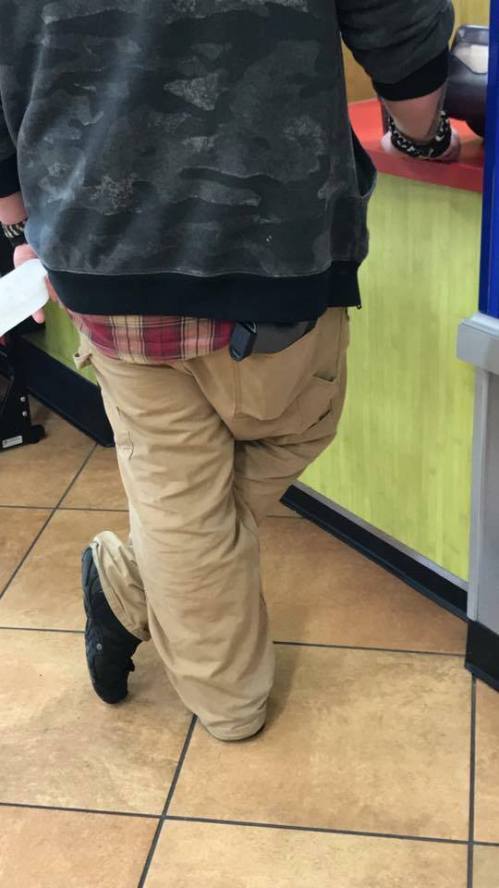
- CARRYING A WEAPON IS A COMPROMISE, AND THERE IS NO PERFECT WEAPON OR PERFECT WAY TO DO IT.
A cliché about carrying a weapon is “the best pistol for self defense is a rifle.” That’s true, but obviously carrying a rifle around everywhere is kind of a pain, and it’s likely to get you kicked out pretty much any place run by regular people. Not only that, if you carry a rifle in public you’ll probably be immortalized on the internet as a dumbass.

So instead of carrying a rifle, you should carry a pistol. Pistols are inherently underpowered, have limited ammo capacity, and are relatively inaccurate due to their short barrels. But they’re the most practical self-defense weapons we’ve got.
What’s the best pistol? That depends on you. What’s your body type? What’s your realistic threat? What’s your level of training? What’s your budget? Generally, you want the best pistol that you can afford that’s reliable, concealable, and powerful enough to sustain an actual gunfight.
I can’t say this enough: the most important concern for a carry gun is not how light and easy to carry it is. There are plenty of great pocket guns, and they definitely have their place. I’ll carry a two-shot .22 Derringer if nothing else is available, but I’d be terrified to have to pull that against a robber threatening my family. Tiny .380, 9mm and even .45 pistols can disappear in a pocket, but they tend to be inaccurate and painful to shoot because they’re so small and light. I’ve seen the web of a friend’s hand bleeding from firing less than a box of .380 through a pocket pistol, which made him not want to shoot it anymore. Any gun that you don’t want to train with isn’t a good carry gun.
So for a daily carry gun, I chose something bigger and more capable but still concealable for my body type. The gun that works best for me is a Glock 43, which is a single-stack 9mm. “Single stack” means the pistol’s magazine has one single row of rounds, versus a staggered row in a double-stack magazine, which means the single stack magazine and pistol grip are narrower, which means the pistol is easier to conceal. When it comes to hiding a pistol, a half-inch difference in width can be a big deal.

Despite what some guy on Facebook said, this just might not be the best carry gun for you.
In case you’re wondering about body types, I’m a little guy at 5’7” and 170 pounds with a (formerly) thin build. It’s usually hard for me to conceal a large pistol unless I wear big untucked shirts, which makes me look like a complete slob. I carried a blocky, chunky Glock 27 for many years, and it was a little hard to hide, so I always wore baggy clothes. I also carried my full-size Glock 22 duty weapon for a time, and looked even sloppier. Now that I’m older and dress a little snappier, I’ve chosen a smaller pistol that’s easier to hide but still capable.
If you’re a huge monster and wear loose clothing, you might be able to easily hide a bigger gun. If you’re a five-foot-nothing beanpole who has to wear a close-fitting uniform, a smaller gun may be a better fit. Maybe. It depends on you personally, and how you’re shaped.
As mentioned above, your manner of dress also comes into play. Not everyone can “dress around their gun.” If you have to wear tucked-in shirts for work or social situations you probably can’t conceal a typical carry gun on your waist, which is usually the most practical way to carry. If you live in a hot climate you’re more limited in what you can conceal than you would be in Fargo ND, where you’d wear a jacket far more often.
Then there’s the threat level, which I mentioned earlier. If I knew for certain I was going to be attacked by an armed criminal, I’d probably stay home with my rifle by my side. But if I had to go out and couldn’t carry my rifle, I’d wear extra clothes so I could hide a full-size pistol with several spare magazines. Fortunately I don’t face that kind of known threat, so I’m comfortable with the G43. If you live in the worst neighborhood in Chicago and have already been robbed twice, your pistol choice should probably be a little different than mine.
And then there’s your budget. There are many reliable, outstanding pistols on the market like Glocks, Sig Sauers, Smith&Wessons, H&Ks and others, but they’re not free. If you can’t afford a quality pistol you may have to get something cheaper like a Ruger, Jennings or even a [shudder] Hi-Point. The point is, get the best pistol you can afford, and whatever you get make sure you understand its capabilities and limitations. I don’t hold anything against a guy carrying a cheap pistol because it’s the only one in his budget, as long as he trains and knows his pistol’s likelihood of failure.
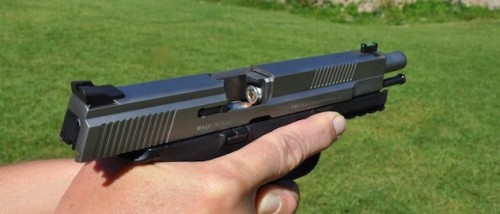
For a time I carried the Beretta Nano in the top picture, which was perfect in every way except that it didn’t work. It failed to extract so often that I had to stop carrying it, and it’s now dying of loneliness in my safe. But if it was all I had, it’s what I’d have to go with. I’d just make sure I practiced malfunction drills like a man possessed.
Note: my advice about carrying a gun is mostly about autos. I’ve trained with a revolver, and I’ve seen some amazingly skilled revolver shooters, but I haven’t owned one in almost twenty years and the ones I did own were just backup guns. Revolvers tend to be a little harder to conceal because of their cylinders, generally have lower ammo capacity, are usually a little slower to reload, and carrying reloads for a revolver is a little more of a pain than carrying spare magazines for an auto. That doesn’t mean you shouldn’t carry a revolver, if you’re well trained with one. It just means I’ve chosen an auto instead. Plenty of revolvers are good carry guns.
- SPEAKING OF GOOD PISTOLS, THEY DON’T “JUST GO OFF.”
This is important. Occasionally I’ll hear of someone preaching that carrying a loaded pistol is just too dangerous because the gun “might just go off.” Maybe that was true of certain older pistols, but a modern, quality weapon will only fire if you pull the trigger. If you don’t trust your pistol enough to carry it loaded, get training; if you still think your pistol is too dangerous to carry loaded, you probably shouldn’t carry it. As long as you train correctly, follow the firearms safety rules and keep your finger off the trigger until you’re ready to shoot, a good pistol will never, ever “just go off.”
The gun in the video below didn’t just go off. The shooter negligently pulled the trigger, while violating other gun safety rules.
Of course, you may have heard that Israeli police and soldiers carry with empty chambers. You may also think that Israelis are the tactical masterminds of the universe and everything they do is right. Well, even though the Israelis do tend to be tactically proficient, the empty chamber thing is kinda goofy. My understanding is that the original Israeli army was equipped with a variety of old pistols, some of which were too dangerous to carry loaded, so they adopted an across-the-board empty chamber policy so they could train everyone the exact same way. For some reason Israel has chosen to continue this training philosophy today, when they have good, modern pistols. But whatevs; just because they do it, doesn’t mean you should.
- NOW LET’S TALK ABOUT SOMETHING TOO MANY GUN OWNERS IGNORE: WEAPON RETENTION.
Before we move on to carry methods, we need to remind ourselves that a gun is NOT a magical talisman (credit to instructor Greg Ellifritz for that phrase). A gun is simply a tool, and if you carry it in a stupid way someone will take it from you and hurt you with it. I once heard a cop say off duty he carried his Glock stuck in his waistband with no holster; I’m sure that’s comfortable and all, but the moment he gets into a physical confrontation and has a loaded, unsecured pistol floating around his waistband, he’s screwed. If you’re going to carry, carry in a way that won’t get you killed if you have to run, fight, or keep someone from taking your gun.
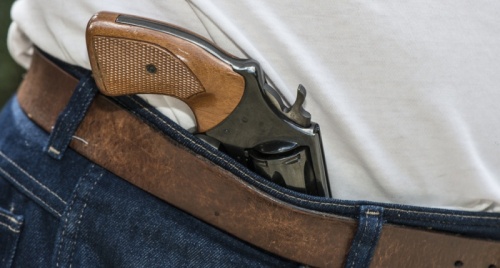
Photo credit Rawstory.com
I first started as a cop in the mid-90s, when we were just realizing how often cops were being disarmed and killed. We were told that a huge percentage of police officers shot and killed were shot with their own or their partner’s gun. Even so, we still had idiot cops who argued against retention holsters (more-secure holsters with secondary locking mechanisms) and used cheap thumb break holsters on duty. But I know officers who were saved by their retention holsters, I’ve discovered my retention holster unsnapped after a fight when I didn’t even realize the suspect was trying to get my gun, and I know of two incidents where suspects couldn’t disarm police officers who were unconscious because they couldn’t figure out the holster. Retention holsters work.
But even though we’ve known the danger of pistol disarms for decades, and even though we’ve had instances of open carriers being disarmed, we still frequently see people carrying guns in non-retention holsters, practically begging bad guys to steal their guns. I don’t get it. It seriously makes zero sense. This goes back to “carrying to prove a point”; I’d guess that most of the people open carrying pistols in crappy holsters are trying to prove something personal or political, and in so doing make bad tactical decisions that put them in more danger.

So keep this in mind: if your weapon is ever going to be exposed in public, you should use a retention holster. And remember that concealment is a level of retention. It’s hard to take someone’s pistol when you don’t even know they have one.
- SO NOW WE MOVE ON TO HOW TO CARRY.
There are many methods of carry, and pretty much all of them make sense in some situations. I’ll address some of the most common, and provide a little insight into their strengths and drawbacks.
- Strong Side Waist, outside waistband (OWB): not bad, but a decent-sized gun on your hip will stick out and maybe “print” (show a gun-shaped object) under your shirt. A thin gun with a good holster that holds it tight to your waist usually alleviates the printing problem. Also, in a physical confrontation you probably have a pretty good chance of protecting your gun if it’s carried strong side waist. On the other hand, one thing to consider is whether or not you can access a gun on your strong side with your weak hand if your strong hand is disabled. In a worst-case scenario, you want to be able to draw with either hand.
- Four o’clock, OWB (over your back pocket on your strong side): I carried this way for years. I was wrong. While it had advantages in that it didn’t stick out to the side and was accessible with either hand, in a physical confrontation it would have been almost impossible to protect. But it’s not always wrong; if you have to wear a suit, for example, it’s not a bad concealment method.
- Small of back OWB: basically the same issues as four o’clock carry.
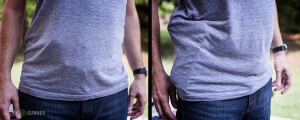
Pistol printing under a shirt. Photo credit Luckygunner.com.
Now, change those from OWB to inside the waistband (IWB). Generally speaking, IWB is far more secure than OWB. On the other hand, it’s way less comfortable. One crappy truth about carrying a pistol is that they’re heavy and uncomfortable. Deal with it, or don’t carry.
More carry methods:
- Ankle carry: good for concealment but terrible for a quick draw, especially if you’re moving. If you’re unfortunate enough to have to run for your life while someone’s shooting at you, you’re not getting that gun out of an ankle holster until you stop or at least slow down. On the plus side, if you’re carrying on the inside of your ankle the weapon is accessible with either hand. Even with easy concealment, that’s still not enough of an advantage to make me choose ankle carry for daily use. Of course, there are plenty of situations where you might not be able to carry any other way, and that’s cool. Just make sure you understand that carry method’s limitations and how it affects your tactical plan.
- Pocket carry: if you have a small enough gun and a good pocket holster, it’s great for concealment. There are many holster makers producing kydex pocket holsters that break up the pistol’s outline in your pocket, and not many people look at other people’s pockets anyway. It’s great for retention, and it’s also not a terribly slow draw with your strong hand. But if you have to draw with your weak hand, it sucks. If you have to draw while seated, it sucks. One important note is that pocket holsters made out of soft materials can be dangerous; I tried one with a Glock 42, and during practice at the range I somehow got my finger inside the holster and brushed the trigger in my pocket while drawing. That’s that, I’ll never use a soft pocket holster again.
- Off-body carry: that is, carrying in a backpack or man purse. While there are situations where it’s necessary or practical, I generally won’t do it unless there’s no other option. Most tactical man purses that carry a gun look exactly like a tactical man purse with a gun, and most backpacks with a gun will take a long time to draw from, so I don’t like that method of carry. That said, I do carry a gun in a small backpack or chest pack when I jog, because there’s really no other way to do it. One of my rules of thumb for carrying a gun is “if it’s not on my body, it’s not loaded.” With all the possibilities of having a bag stolen, or having to take it off in formal situations like business meetings, I’d be real nervous about having a loaded pistol in a bag. But as I said, there are times it makes sense.
- Shoulder holster carry: never done it [EDITED TO ADD, I remembered that I actually have done it, but only as a tanker in the military, never in public]. I’ve seen a lot of older cops do it, younger guys not so much. I’m told it makes sense when you’re wearing a suit or flying a helicopter. One thing I was warned about is that in a physical confrontation we automatically take a bladed stance against our opponent, and if you’re using a shoulder holster you’re actually putting your pistol closer to him butt first, which makes it easier for him to grab. I’ve also never seen or heard of a retention security holster; they all just have a single snap thumb break, as far as I know.
- Cross draw: I can only think of one situation where this might make sense, and that’s drawing a pistol while seated in a car or other confined space. But that possible advantage disappears the minute you’re on your feet; now you have to reach in front of your own body to draw your weapon, which you probably can’t do if you’re rolling around in a fight. You also probably can’t draw at all with your weak hand, and if you do draw you have to make an arcing motion to bring the weapon on target so you’ll probably swing past your target and have to reverse motion to bring it back. Cross draw is slow, impractical and dangerous. One of the biggest indicators that a gun carrier has no idea what he’s doing is if he’s carrying in a cross draw holster. I’ve never seen a well-trained shooter carrying cross draw and never heard of any reputable instructor advocating it. I’m all ears, though; if someone knows good reasons to do it, please let me know in the comments.
- Appendix carry (IWB just off center from your navel): uncomfortable, awkward, fear-inducing because you’re just sure you’ll shoot your weiner off, and one of the best carry methods out there. Appendix carry is extremely secure, and with a good appendix holster you can run and fight without the slightest worry about losing your gun. It’s also one of the fastest draws. On the negative side, if you have a gut it’ll push the grip outward and make your pistol print. Also, appendix carry generally requires two hands for reholstering your weapon, which might cause a problem in some situations. And no matter how much you train to shoot from appendix, you never quite stop worrying about shooting your junk. I carry appendix almost exclusively, and will probably always feel a tinge of worry about it.

Me appendix carrying at a training course a few years ago.
There are other carry methods, but I’ll stop with these. If anyone has questions about others, please leave a comment.
- AT THIS POINT, WE PROBABLY NEED TO DISCUSS PEOPLE YOU SHOULDN’T LISTEN TO ABOUT CARRYING A GUN.
Unfortunately, the gun world is full of guys with an ounce of experience and a ton of advice. Many of them have literally no business telling anyone how to carry, because they don’t know how to do it correctly themselves. So let’s talk about a few types of people who give bad advice:
- Pretty much any random guy on the internet. The net is a vast cesspool of bad advice, and the random people offering tips in discussion forums are often the worst offenders. If random guy says something that sounds good to you, even if I’m the random guy, find a legitimate source confirming it before you believe it.
- Bearded, overweight guys at ranges, gun shows and gun stores who start conversations with “I was a Navy SEAL on Recon Team Delta during the Battle of Fallujah off the coast of Afghanistan in 2010.” The gun world attracts liars and posers like Twinkies attract Rosie O’Donnell. A rule of thumb for life is to not believe anyone who claims to be a Special Forces hero without evidence, and that’s doubly important for a new shooter and gun carrier.
- MANY veterans. “Veteran” can mean anything from Delta Force pistol instructor to a cook in a mess kit repair unit, and there are a lot more cooks than Delta Force instructors in the military. Most troops get little to no pistol training, so unless you know a veteran has advanced training there’s no reason to believe they’re skilled with a pistol just because they served.
- MANY gun store employees and dealers at gun shows. Gun businesses are businesses; good ones won’t sell crappy or unsuitable guns to new shooters, bad ones don’t care what you buy as long as they make a profit. Back in 1995 when Texas passed the concealed carry law, some dumbass gun show dealer tried to sell me an AR-15 pistol for concealed carry. So if you’re new to the gun world, don’t walk into a gun store and expect every employee to give you only the best advice. Far too many only care about getting your money.
- Most cops. Yeah, I said it. I’m super proud of my police brothers and sisters, but damn, a lot of them only train when they absolutely have to. I know cops who fire exactly fifty rounds a year, because that’s all they need to shoot for annual qualification. I know cops who refuse to carry a gun off duty. Being a cop does not automatically equal being well trained; also, as far as concealed carry goes, remember that cops don’t have to worry about getting in trouble if someone sees their gun. A cop might say, “I’ve carried in a Serpa holster on my right hip for years and never had a problem,” and they’re right. But part of the reason they’ve never had a problem is because it doesn’t matter if they get spotted with a gun, so they don’t care if they’re sloppy about concealment.
- Anyone whose basis for giving advice is “I’ve never had a problem with [my gun/ammo/holster/etc].” Sure, someone can “never have a problem” with something; that doesn’t mean they’ve ever actually trained with or tested their gear. A beloved relative of mine (may he rest in peace) carried a cheap .25 in his pocket for years and never had a problem with it. Then he finally took it to the range, pulled the trigger and found out it was broken and wouldn’t fire. The cop I mentioned earlier could have carried his Glock just stuck in his waistband and never had a problem with it, as long as he never had to actually run or fight. There’s a certain brand of holster a lot of people use and never have problems with, because thus far nobody has torn their cheap holster off its paddle, (which is easy to do). A shooter with a notoriously unreliable pistol can brag about how he’s never had a problem with it, without mentioning he only fires one box of twenty rounds through it every other year. Pistols like Glocks and Sigs have been repeatedly torture tested and continued to fire, and many reputable companies make great holsters that stand up to abuse. One person’s personal experience with what may be the worst piece of gear or weapon ever built isn’t a valid reason for you to mimic him.
- The guy who says, “I carry a .45 cuz they don’t make a .46, HAR HAR HAR!!” or any other version of “a real man carries a huge gun.” If you ever hear that, just slowly back away. Trust me.
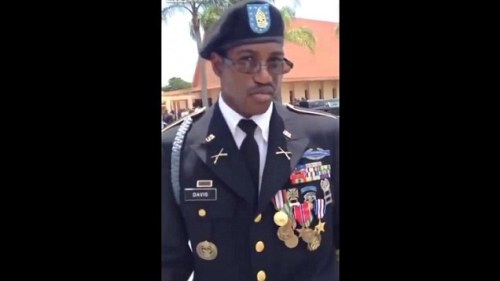
“But this Army Green Beret guy told me he’s carried a Hi-Point for years and never had a problem with it.”
- BUT LET’S MOVE ON TO SOMETHING NEAR AND DEAR TO MY HEART: SPARE AMMO.
For reasons I will never, ever, EVER understand, many gun carriers are convinced they’ll never need to reload. They carry their weapon with one mag in the mag well, and that’s it. “Well of course!”, they might say. “I carry a Glock 19 with a seventeen-round magazine, why would I need more than that?”
BECAUSE THINGS GO WRONG. Shooters in a gunfight shoot more and faster than they realize. Ammo fails. Magazines fail. Weapons double feed, requiring you to strip your magazine from the pistol, rack the slide several times, reinsert a mag and reload. Are you planning on stripping your mag from your weapon and taking the time to put it in your pocket, clearing your weapon, then taking the magazine back out (and maybe having to reseat or strip the top round because it’s sticking up vertically, as sometimes happens during double feeds) and then reloading, all while someone’s shooting at you? What if you’re running while clearing your weapon, how easy will it be to clear and reload with the same magazine?
Double feed. Photo credit Dailycaller.com.
In real life, malfunctions happen even with the best of weapons. You can accidentally bang your pistol on a wall and unseat the magazine. You can induce a malfunction with an improper grip during a rushed draw. Or, far more likely, you can empty your weapon in seconds without realizing it (like the cop who shot a guy pointing a gun at me years ago; the officer thought he fired two or three rounds, when he had fired eight). Don’t be the guy who never thought he needed spare ammo, and died with an empty gun in his hand. That would be embarrassing.
Spare mags can be carried several ways, from belt pouches to mag holsters that clip to the inside of your pocket to carrying loose in a pocket. Respected tactical trainer Matt Graham taught me several years ago that pocket carrying mags works fine, and that’s what I’ve done since then. Others prefer different methods. However you do it, just do it.
One brief side note: if you get a small auto like a Glock 43 that only carries six rounds in a short magazine, remember that you only need ONE six-round mag. You might need that magazine in the gun for concealment, but your spare mags can have extensions to give you more ammo capacity. All my spare mags have +2 or +3 mag extensions from a reputable manufacturer. But whatever you do, don’t buy cheap mag extensions.
- THE CURSE OF THE “GET OFF ME GUN”
I’ve heard people say they just carry a “get off me gun” (GOMG). This is a weapon intended to just make an attacker stop his attack, not necessarily to incapacitate them. A Derringer, .25 Raven or any number of other small pistols are often referred to as GOMGs. People who carry them frequently don’t bother carrying spare ammo, and often say things like “I just plan on shooting it over my shoulder as I’m running away” or “It might not kill ‘em, but by god it’ll make ‘em quit coming at me.”
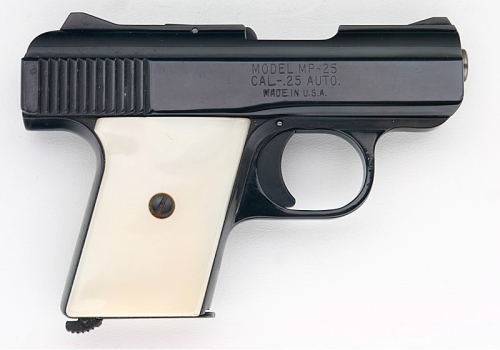
.25 Raven. Photo credit Auction Arms.
No it won’t. If you’re going to carry a gun, please, for the love of god, study the realities of gunfights. Determined attackers often take multiple hits and continue shooting, stabbing or punching. Even an unsurvivable wound might not kill someone for a while, as we saw back in the 1986 Miami FBI shootout where a robber/murderer took a lethal hit in the first few seconds of a fight but still managed to kill two FBI agents and wound several others before dying. Real life bullets don’t do what TV and movie bullets do, and if you think you’ll always drop someone with one dramatic shot you’re just wrong. GOMGs are typically underpowered with poor ballistic performance, and will likely be ineffective against someone high or drunk (or even just really mad, like one of the suspects in the FBI shootout).
Also, what if you’re not alone? The guy who plans on shooting as he’s running away seems to have failed to consider, oh, being robbed in the Wal-Mart parking lot while he’s with his wife and kids. Is he going to abandon his family and shoot over his shoulder while running away? Unfortunately, you don’t get to write the script for your gunfight. If you’re an armed citizen, any confrontation you have with a criminal is almost guaranteed to be an ambush where the criminal chose the time, location, and method of confrontation. You’ll already be on the defensive, don’t make it worse by carrying a GOMG with no spare ammo.
Again, there are situations where a GOMG is all you can get away with, and ya gotta do what ya gotta do. But for daily carry, I strongly recommend you carry a larger pistol you can actually fight with.
There are many, many more factors involved with carrying a gun, but I’ll stop here for now. If anyone has counter arguments to my points, please present them in the comments. I ain’t no expert on nuthin’, I’m always learning, and if I’m wrong about something I will gladly acknowledge my mistake. Thanks for reading, and if you’re going to carry a gun in public, please keep this in mind: a lethal force encounter is one of the most demanding, intense, complex situations anyone could ever face. If you’re untrained and get into a gunfight against an opponent with any skill whatsoever, you’re almost guaranteed to lose. So for yourself, your family and your fellow citizens, TRAIN WITH YOUR GUN.
—————————-
This post is dedicated to the memory of Kevin O’Brien, writer of the Weaponsman blog, who passed away unexpectedly last week. Kevin was a retired Special Forces Soldier, fellow Afghanistan veteran, true American patriot, genius about weapons, and hell of a nice guy. He enthusiastically supported my writing, and wrote the back cover blurb for my novel Line in the Valley. Kevin was taken from us far too soon, will be missed by many, and is hopefully enjoying the peace he truly earned. Rest in peace, brother.

Chris Hernandez (pictured above) is a 23 year police officer, former Marine and retired National Guard soldier with over 25 years of military service. He is a combat veteran of Iraq and Afghanistan and also served 18 months as a United Nations police officer in Kosovo. He writes for BreachBangClear.com and has published three military fiction novels, Proof of Our Resolve, Line in the Valley and Safe From the War through Tactical16 Publishing. He can be reached at [email protected] or on his Facebook page (https://www.facebook.com/ProofofOurResolve).
]]>