“This is it? What, is it the economy model?”
“No, smartass,” Nguyen answered with an eyeroll. “This is literally the highest tech that exists anywhere in the world. You and your boys will walk into it, and walk out the other side into 1881 West Texas. Specifically, you’ll walk out of the Sutler’s store at Fort Davis.”
Vic tilted his head and looked at the machine again. Nothing about it was impressive. The entire device filled only a half-size conex container, painted dull grey, with a complicated network of cables and wires running from the back end to dozens of computers and monitors spread throughout the darkened warehouse. Red lights provided a faint glow over the device and monitoring stations, and the dull hum of cooling units didn’t quite impede normal conversation.
“If this was the only one,” Vic asked, “how did the Chinese get it?”
“No idea,” Pena Rodriguez said. “It must have been a cyber breach. I mean, the only person here with access to all the plans and data is Elsie, our transsexual intelligence analyst. She’s a sweetheart though, she’d never steal the plans and give them to Wikileaks or anything like that.”
Vic looked toward one of the workstations. A skinny, bucktoothed, pink-haired guy in a dress lifted a disc from a computer drive. He saw Vic, froze, dropped the disc back into the drive, tapped his fingertips together and innocently whistled Born This Way.
“How many Soldiers will I have?” Vic asked.
“Ten. Including you.”
“That’s it?”
“What, are you scared?’ Nguyen asked. “Ten is plenty. How many do you expect the Chinese to send, a hundred? At best they’ll put five guys through their machine, then you and the 8thCavalry troopers at Davis will whip their ass in minutes. You’ll have M4s, SAWs, an M-240, AT-4s, grenades, body armor, everything. If anything, it’ll be too easy.”
“I’ve heard that shit before,” Vic muttered. “What makes you so sure it’ll only be five Chinese?”
“Our intel is solid,” Nguyen said. “There’s no doubt. Has the CIA ever been wrong?”
“Well, yeah,” Vic replied. “Remember that whole ‘weapons of mass destruction in Iraq’ thing?”
“Nobody cares about Iraq!” Pena Rodriguez yelled. “That’s in the past! What matters is what’s happening today…and what happened in the past.”
“If what happened in the past matters, doesn’t that include Iraq?”
“No,” Nguyen said. “We’re only concerned with the 1880s. And I guarantee the CIA had no intelligence failures then.”
Vic looked away and shook his head. “Tell me the plan.”
“Nothing to it,” Pena Rodriguez said. “You ten vets go through, make contact with the camp commander, and give him the cover story. There’s one minor obstacle, we can’t send people and weapons through at the same time, so you’ll get the weapons half an hour later. Then you set the defense, kill the Chinese, repel the Apaches, shake hands and kiss babies, and ride off into the sunset back to today. We’ll time your return to the Saturday evening when we knocked on your door. You won’t even miss a day of work.”
“Huh,” Vic said, with obvious doubt. “And we’ll be able to fight right after going through? Time travel isn’t going to mess us up?”
“Not at all,” Nguyen said. “Well, not really. There might be a little digestive and urinary upset, but it won’t affect your ability to fight. Right after the passage you might have a slight stomach ache and need to pee a couple times, then it goes away.”
“Does the Chinese machine do the same thing?”
“Of course,” Pena Rodriguez said. “They stole our plans, so it has to.”
“Quit worrying about irrelevant crap!” Nguyen blurted. “Focus on the mission. All that matters is how you and your troops will defend Fort Davis.”

US Army troops at Fort Davis. Photo from TrueWestMagazine.com
Vic rubbed his forehead. “Speaking of that, what makes you people think the other vets will follow me anyway? I was just an E-4 team leader, nothing special.”
“Oh, they’ll follow you,” Nguyen said. “We told them about the heroic way you lost your leg in Afghanistan. They’ll go anywhere with you.”
“God dammit,” Vic said, biting back anger. “Do you people know how I actually lost my leg?”
“Nobody cares exactlyhow you lost your leg,” Pena Rodriguez hissed. “What matters is that you gave a piece of your protective gear to one of your Soldiers who didn’t have his, and it cost you your leg.”
“Well…yeah,” Vic stammered. “Sort of. But that’s not the whole-”
“It doesn’t matter!” Nguyen yelled. “They’ll follow you because you’re a hero. And besides that, they’re all descendants of Apache, just like you. We told them you’re Victorio’s great-great-great-great grandson. That’s all it took. You’re the man.”
“I’m not a freakin’ hero!” Vic shouted back. “And I was only in the damn Army for three years. I’m no tactical genius and was never even in command of nine people, I was just a fireteam leader in charge of three Joes. Now you dickheads think I can go back in time and lead a ten-man squad against Chinese cyberweirdos and an army of Apaches? Really?”
“Yes,” Pena Rodriguez said. “Really. Now if you’re done whining, let’s go to building 8 and meet your team.”

Chris Hernandez (pictured above at Fort Davis) is a 25-year police officer, former Marine and retired National Guard soldier with over 25 years of military service. He is a combat veteran of Iraq and Afghanistan and also served 18 months as a United Nations police officer in Kosovo. He writes for BreachBangClear.com and has published three military fiction novels, Proof of Our Resolve, Line in the Valley and Safe From the War through Tactical16 Publishing. He can be reached at [email protected] or on his Facebook page (https://www.facebook.com/ProofofOurResolve).
]]>I recently visited Fort Davis, Texas, on a family vacation. The landscape reminded me of Afghanistan, and the combination of Afghanistan landscape with an old west army fort reminded me of a book I heard of in the 1980s: Remember the Alamo.
Remember the Alamo was written by Kevin Randle and Robert Cornett. I never read it, but when I saw the cover in high school I laughed my ass off. The plot has something to do with Vietnam veterans going back in time to defend the Alamo in 1836. Randle and Cornett also wrote two similar books about Vietnam vets going back in time, Remember Gettysburg and Remember Little Bighorn. I never read those either, and based on Amazon reviews it looks like almost nobody did. That’s a shame, because Randle and Cornett came up with a really cool idea.

So I’ve decided to write a novella with a similar idea, about an Afghanistan vet who goes back in time to defend Fort Davis from an Apache attack (that never happened). I visited Fort Davis Tuesday, started thinking about a story that day, then wrote this first chapter last night and this morning. I hope you enjoy it, and I’m totally open to ideas for changing or improving it. I plan on publishing each chapter here as I write them, and who knows, maybe enough people will like it that I’ll eventually publish it as a real book.
I dedicate this story to Kevin Randle and Robert Cornett, and if anyone likes my story hopefully they’ll read Remember the Alamo. I plan on reading it soon.
————————————————————
THE DEFENSE OF FORT DAVIS
A Totally Non-Historical Historical Novel
Chapter 1
Vic Johannsen sat back on his couch, exhausted. All the boxes were put away, random housewares that had cluttered the living room floor were in their proper place, new friends who’d lent a hand were headed home. He was moved in, and the moving hadn’t even hurt his stump. Not enough to bother him, anyway.
Vic had taken ten long years to get to this point. After an uneventful start in the Army he’d deployed to Afghanistan, and eight months later it happened. He’d handled it just fine, of course, but coming home minus a lower leg had kind of jacked up his post-Army plans. He’d spent a few years living with mom and going to college on the G.I. Bill, changed his major three times, and finally quit. He worked a string of menial jobs that gave him absolutely zero satisfaction. He applied for his local fire department, then police department, then ambulance service, and withdrew every application. He married, was blessed to have no children, and divorced less than two years later. Nothing he’d tried felt right.
Then he heard about Houston and its booming petrochemical industry. The very first application he submitted produced four replies, and within a week he’d accepted a job with better benefits and salary than he’d dared expect. Two weeks later he was settled into his new apartment in Houston, with three very happy first days of work behind him. On day one he’d caught the eye of a beautiful Latina in Accounting; Vic was tall, wiry, sandy-haired but with dark black mysterious eyes, had looked like and been a perfect soldier until the injury, and some girls liked that. He had no one to take care of except himself, no car or mortgage debt, no child support, no alimony, no student loans, nothing but opportunity and success ahead, and his favorite kind of woman was interested in him. Life was fantastic.
Someone knocked on the door.
“Dangit,” Vic muttered, in his hometown’s drawl. He struggled off the couch, briefly rubbed his stump, hopped to the door and pulled it open. Two men stood at the door wearing matching black suits, black sunglasses, and Brady Bunch-white skin and blond hair. Neither said a word.
Vic looked from one to the other, then back, waiting for them to speak. Nothing.
“Can I help you?”
“Mr. Victor Johannsen, we need to speak in private,” one said. “Inside.”
“About what? And do I know you?”
“This is vitally important, Mr. Johannsen,” the other said. “Or should I call you…Victorio Calanche Johannsen?”
Vic’s eyes narrowed. Nobody had ever called him Victorio except his great grandmother, who’d named him. And the only time he’d ever used Calanche, his great grandmother’s last name, was on his high school diploma.
“Who are you people?”
“I’m Agent Juan Carlos Pena Rodriguez,” Brady family member number one said. “And this is Agent Duc Nguyen.”
“Those are our real names,” Brady member number two said. “Not aliases.”
Vic stared at the two men, who looked like they should be named Chad and Brent. “Um…okay. You people should probably tell me what you want.”
Agent Pena Rodriguez said, “Victorio, we know about your Apache ancestry. And because of it, your country needs your help.”
“What? How do you know about my ancestry?”
“You took a DNA test,” Agent Nguyen said. “We have the results.”
“Bull. DNA tests can’t tell what tribe you’re from.”
“You researched your genealogy and built a family tree in high school,” Agent Pena Rodriguez said. “We have it.”
“Fine,” Vic sighed. “What does my Apache ancestry have to do with anything?”
“Nobody cares about your Apache ancestry,” Agent Nguyen said. “What matters is what America needs you to do.”
“What the…you just said my Apache ancestry-”
“What we’re talking about, Victorio,” Agent Pena Rodriguez said, “is the heroic way you lost your leg in Afghanistan. And why it makes you indispensable for a new mission.”
“The way I lost my leg?” Vic blurted. “Do you have any idea how I actually lost my leg?”
“Nobody cares how you lost your leg,” Agent Nguyen said. “That’s ancient history. All that matters now is the future. And the past.”
“Wait,” Vic stammered. “You just said nobody cares about the ancient history but all that matters is the past, or…something. What is this about?”
“Let’s go inside and talk,” Agent Pena Rodriguez said.
“Hell no!” Vic said. “I don’t even know who you are. Show me badges or something.”
“We’re not the kind of agents who have badges,” Agent Nguyen said softly. “And we’re not the kind of agents who can tell you what agency we work for. But we can tell you that the best way to help yourself is to help us help you help America.”
“Help…what? This is stupid. Tell me what agency you’re from.”
“You know the U.S. Geological Survey?” Agent Pena Rodriguez asked. “The agency responsible for mapping all American archaeological sites?”
“Yeah, I’ve heard of it.”
“We’re from the CIA.”
Vic blinked hard. “But you just said-”
“Tell us what you know about Fort Davis, Mr. Johannsen,” Pena Rodriguez demanded. “The fort, not the town.”
“Fort Davis, Texas? I grew up in Alpine, right near there. It’s just an old Army base from the 1800s.”
“It’s not just an old army base,” Pena Rodriguez said. “Not to you. Fort Davis was your life. You volunteered to help restore parts of the fort, were a volunteer Park Ranger, and worked there as a tour guide. You were in a reenactor group and played an 8thCavalry trooper. You spent nights in the barracks with the Boy Scouts. You hiked all the trails and climbed all the mountains overlooking the fort. You drew pictures of it from memory and sold them to tourists. You wanted to know what it was like to sleep like a soldier so you took your 1880s field gear into the mountain over the fort and tried to spend a night, wound up with hypothermia, and had to be rescued. Your friends made fun of you, but you went back a week later and did it again, successfully that time. The first time you got lucky was at Fort Davis, when you and your girlfriend Jeannie snuck onto the fort one night during senior year. You know that Fort better than any soldier in America.”
“Whoa,” Vic said, eyes wide. How the hell did they know all that? “Yeah, I was a history nerd as a kid, and yeah, I loved Fort Davis. But-”
“Nobody cares how you felt about Fort Davis,” Nguyen said. “That’s all in the past. All we care about is what you can do today, tomorrow…and yesterday.”
“Yesterday? What the fu-”
“You also know that Fort Davis protected the vital San Antonio-to-El Paso road,” Pena Rodriguez said. “The road that all of America, even now, relies on for security and prosperity. The road that, if it ever fell to the enemy, in the 1800s or today, would mean the death of the United States of America.”
“What? It’s wasn’t that-“
“And, I might add,” Pena Rodriguez said, “Your great-great-great-great grandfather, Apache Chief Victorio, the man your great grandmother Hilaria Calanche named you after, was famous for attacking soldiers and wagon trains on that road.”
“Well…yeah,” Vic said, confused. “He was. What does that have to do with me?”
“Nobody cares what that has to do with you,” Nguyen said. “All that matters is why you wanted to know everything about Fort Davis. Everyone thought you dreamed of being an old west soldier, but you didn’t. The truth is that you wanted to know them because you fantasized about helping your great great great great grandfather Victorio defeat them. You wished you’d been an Apache warrior fighting by Victorio’s side. You wanted to know how to overrun Fort Davis.”
Vic’s eyes popped open. “Alright, you two are creeping me out. How did you know that?”
“How do you know we know that?” Nguyen asked.
“Uh…because you just told me?”
“No,” Pena Rodriguez said. “We didn’t know until you admitted to all of it just now.”
“I didn’t admit to anything!” Vic yelled. “And Jesus Christ, I was a kid. So what if I dreamed about-”
“We’re only here to find out one thing,” Nguyen said. “And you need to tell us the truth.”
“The truth about what?”
“What,” Pena Rodriguez asked, in a slow, deliberate tone, “do you know about the attack on Fort Davis?”
“There was no attack on Fort Davis!” Vic yelled. “It was never attacked. The Army closed it in 1891 because it wasn’t needed anymore.”
“That’s where you’re wrong, Vic,” Nguyen said. “What you mean to say is, Fort Davis was never attacked before it closed in 1891…yet.”
Vic squinted and pursed his lips. “You people are idiots. Bye.” He started to slam the door, but Nguyen quickly blocked it with his foot.
“Victorio, your country needs you again,” Pena Rodriguez said quietly. “More than it’s ever needed you before. Before you say no, understand that the safety and security of every last American man, woman and child depends on you. More than that, America’s very existence depends on you. Think about that.”
Vic gave him a hard look. Everything about Pena Rodriguez and his partner reeked of horsecrap. On the other hand, they did know things about him that nobody else knew. That had to mean…well, something, right? And as a soldier, wasn’t he supposed to step up for his country?
What if they’re telling the truth about America needing me?
“What the hell,” Vic said, knowing he was making a mistake but throwing the door open anyway. “Come on in.”
———————————————-
Chris Hernandez (pictured above at Fort Davis) is a 25-year police officer, former Marine and retired National Guard soldier with over 25 years of military service. He is a combat veteran of Iraq and Afghanistan and also served 18 months as a United Nations police officer in Kosovo. He writes for BreachBangClear.com and has published three military fiction novels, Proof of Our Resolve, Line in the Valley and Safe From the War through Tactical16 Publishing. He can be reached at [email protected] or on his Facebook page (https://www.facebook.com/ProofofOurResolve).

Lately we’re seeing a lot more citizens getting carry permits or exercising constitutional carry rights and going armed in public. That’s a great thing. We’re also seeing more and more social media posts showing people carrying the wrong weapons and/or carrying in ways that actually put them in more danger. That’s a bad thing. So I’m going to try to do something about it, and provide some basic information for people new to the world of carrying a pistol.
I’m not writing this from the standpoint of a tactical master; I’m no Paul Howe or Mike Pannone, and if they say anything that contradicts my advice, listen to them. However, I’ve been carrying a gun as a Marine, Soldier and cop for over twenty years, I’ve got a fair amount of training, and I’ve learned what works and what doesn’t through that training, my mistakes and painful experience, other people’s experience, and trial and error. Also, I’m not trying to sell you anything. While I write for a website that advertises weapons and accessories, and have tested and advertised some firearms and products, I’m not writing this to push any company or product. I’m just telling you what I know and how I know it, suggesting you consider it, and asking you to decide for yourself if my advice will help you.
So I’ll present a list a points and explanations, in no particular order. Keep in mind, I’m writing for people who can legally own a gun and will legally carry according to their local laws. With that said, here we go.
- IF YOU’RE CARRYING A GUN FOR ANY REASON OTHER THAN TO DEFEND YOURSELF, YOUR FAMILY AND OTHER INNOCENT PEOPLE AROUND YOU, YOU’RE PROBABLY DOING IT WRONG.
Carrying a gun is all about practicalities and reality. Generally speaking, you shouldn’t carry to prove a point, especially a political point. If your motivation is to prove something, you’re likely ignoring practical considerations and tactical realities. For example, in most situations you’re better off with a concealed rather than openly carried weapon. But if you’re trying to prove something, you’ll probably make a bad tactical decision (like open carrying without a security holster) and draw attention that puts you in more danger than if you were unarmed.
As a cop, I urge every responsible citizen to legally carry. But don’t do it in a dumb way that accomplishes the exact opposite of what you’re trying to do.
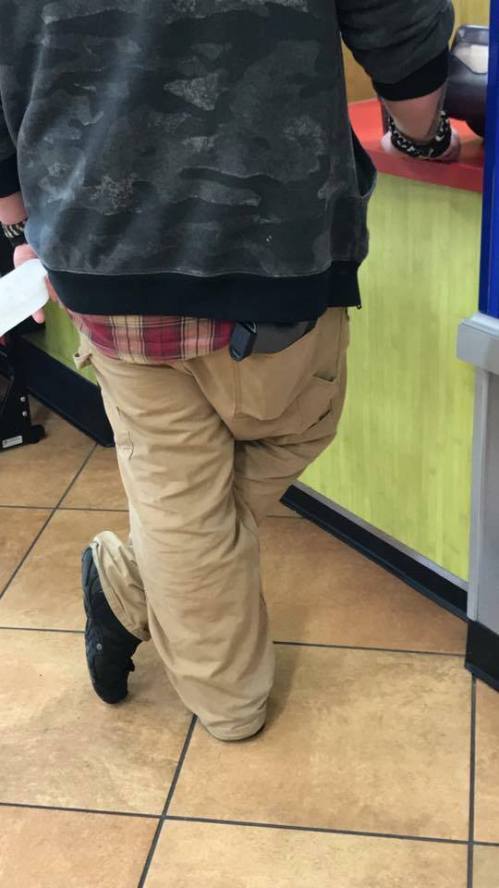
- CARRYING A WEAPON IS A COMPROMISE, AND THERE IS NO PERFECT WEAPON OR PERFECT WAY TO DO IT.
A cliché about carrying a weapon is “the best pistol for self defense is a rifle.” That’s true, but obviously carrying a rifle around everywhere is kind of a pain, and it’s likely to get you kicked out pretty much any place run by regular people. Not only that, if you carry a rifle in public you’ll probably be immortalized on the internet as a dumbass.

So instead of carrying a rifle, you should carry a pistol. Pistols are inherently underpowered, have limited ammo capacity, and are relatively inaccurate due to their short barrels. But they’re the most practical self-defense weapons we’ve got.
What’s the best pistol? That depends on you. What’s your body type? What’s your realistic threat? What’s your level of training? What’s your budget? Generally, you want the best pistol that you can afford that’s reliable, concealable, and powerful enough to sustain an actual gunfight.
I can’t say this enough: the most important concern for a carry gun is not how light and easy to carry it is. There are plenty of great pocket guns, and they definitely have their place. I’ll carry a two-shot .22 Derringer if nothing else is available, but I’d be terrified to have to pull that against a robber threatening my family. Tiny .380, 9mm and even .45 pistols can disappear in a pocket, but they tend to be inaccurate and painful to shoot because they’re so small and light. I’ve seen the web of a friend’s hand bleeding from firing less than a box of .380 through a pocket pistol, which made him not want to shoot it anymore. Any gun that you don’t want to train with isn’t a good carry gun.
So for a daily carry gun, I chose something bigger and more capable but still concealable for my body type. The gun that works best for me is a Glock 43, which is a single-stack 9mm. “Single stack” means the pistol’s magazine has one single row of rounds, versus a staggered row in a double-stack magazine, which means the single stack magazine and pistol grip are narrower, which means the pistol is easier to conceal. When it comes to hiding a pistol, a half-inch difference in width can be a big deal.

Despite what some guy on Facebook said, this just might not be the best carry gun for you.
In case you’re wondering about body types, I’m a little guy at 5’7” and 170 pounds with a (formerly) thin build. It’s usually hard for me to conceal a large pistol unless I wear big untucked shirts, which makes me look like a complete slob. I carried a blocky, chunky Glock 27 for many years, and it was a little hard to hide, so I always wore baggy clothes. I also carried my full-size Glock 22 duty weapon for a time, and looked even sloppier. Now that I’m older and dress a little snappier, I’ve chosen a smaller pistol that’s easier to hide but still capable.
If you’re a huge monster and wear loose clothing, you might be able to easily hide a bigger gun. If you’re a five-foot-nothing beanpole who has to wear a close-fitting uniform, a smaller gun may be a better fit. Maybe. It depends on you personally, and how you’re shaped.
As mentioned above, your manner of dress also comes into play. Not everyone can “dress around their gun.” If you have to wear tucked-in shirts for work or social situations you probably can’t conceal a typical carry gun on your waist, which is usually the most practical way to carry. If you live in a hot climate you’re more limited in what you can conceal than you would be in Fargo ND, where you’d wear a jacket far more often.
Then there’s the threat level, which I mentioned earlier. If I knew for certain I was going to be attacked by an armed criminal, I’d probably stay home with my rifle by my side. But if I had to go out and couldn’t carry my rifle, I’d wear extra clothes so I could hide a full-size pistol with several spare magazines. Fortunately I don’t face that kind of known threat, so I’m comfortable with the G43. If you live in the worst neighborhood in Chicago and have already been robbed twice, your pistol choice should probably be a little different than mine.
And then there’s your budget. There are many reliable, outstanding pistols on the market like Glocks, Sig Sauers, Smith&Wessons, H&Ks and others, but they’re not free. If you can’t afford a quality pistol you may have to get something cheaper like a Ruger, Jennings or even a [shudder] Hi-Point. The point is, get the best pistol you can afford, and whatever you get make sure you understand its capabilities and limitations. I don’t hold anything against a guy carrying a cheap pistol because it’s the only one in his budget, as long as he trains and knows his pistol’s likelihood of failure.
For a time I carried the Beretta Nano in the top picture, which was perfect in every way except that it didn’t work. It failed to extract so often that I had to stop carrying it, and it’s now dying of loneliness in my safe. But if it was all I had, it’s what I’d have to go with. I’d just make sure I practiced malfunction drills like a man possessed.
Note: my advice about carrying a gun is mostly about autos. I’ve trained with a revolver, and I’ve seen some amazingly skilled revolver shooters, but I haven’t owned one in almost twenty years and the ones I did own were just backup guns. Revolvers tend to be a little harder to conceal because of their cylinders, generally have lower ammo capacity, are usually a little slower to reload, and carrying reloads for a revolver is a little more of a pain than carrying spare magazines for an auto. That doesn’t mean you shouldn’t carry a revolver, if you’re well trained with one. It just means I’ve chosen an auto instead. Plenty of revolvers are good carry guns.
- SPEAKING OF GOOD PISTOLS, THEY DON’T “JUST GO OFF.”
This is important. Occasionally I’ll hear of someone preaching that carrying a loaded pistol is just too dangerous because the gun “might just go off.” Maybe that was true of certain older pistols, but a modern, quality weapon will only fire if you pull the trigger. If you don’t trust your pistol enough to carry it loaded, get training; if you still think your pistol is too dangerous to carry loaded, you probably shouldn’t carry it. As long as you train correctly, follow the firearms safety rules and keep your finger off the trigger until you’re ready to shoot, a good pistol will never, ever “just go off.”
The gun in the video below didn’t just go off. The shooter negligently pulled the trigger, while violating other gun safety rules.
Of course, you may have heard that Israeli police and soldiers carry with empty chambers. You may also think that Israelis are the tactical masterminds of the universe and everything they do is right. Well, even though the Israelis do tend to be tactically proficient, the empty chamber thing is kinda goofy. My understanding is that the original Israeli army was equipped with a variety of old pistols, some of which were too dangerous to carry loaded, so they adopted an across-the-board empty chamber policy so they could train everyone the exact same way. For some reason Israel has chosen to continue this training philosophy today, when they have good, modern pistols. But whatevs; just because they do it, doesn’t mean you should.
- NOW LET’S TALK ABOUT SOMETHING TOO MANY GUN OWNERS IGNORE: WEAPON RETENTION.
Before we move on to carry methods, we need to remind ourselves that a gun is NOT a magical talisman (credit to instructor Greg Ellifritz for that phrase). A gun is simply a tool, and if you carry it in a stupid way someone will take it from you and hurt you with it. I once heard a cop say off duty he carried his Glock stuck in his waistband with no holster; I’m sure that’s comfortable and all, but the moment he gets into a physical confrontation and has a loaded, unsecured pistol floating around his waistband, he’s screwed. If you’re going to carry, carry in a way that won’t get you killed if you have to run, fight, or keep someone from taking your gun.
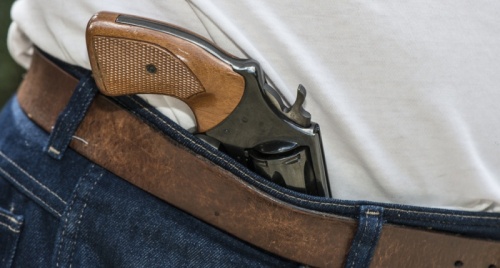
Photo credit Rawstory.com
I first started as a cop in the mid-90s, when we were just realizing how often cops were being disarmed and killed. We were told that a huge percentage of police officers shot and killed were shot with their own or their partner’s gun. Even so, we still had idiot cops who argued against retention holsters (more-secure holsters with secondary locking mechanisms) and used cheap thumb break holsters on duty. But I know officers who were saved by their retention holsters, I’ve discovered my retention holster unsnapped after a fight when I didn’t even realize the suspect was trying to get my gun, and I know of two incidents where suspects couldn’t disarm police officers who were unconscious because they couldn’t figure out the holster. Retention holsters work.
But even though we’ve known the danger of pistol disarms for decades, and even though we’ve had instances of open carriers being disarmed, we still frequently see people carrying guns in non-retention holsters, practically begging bad guys to steal their guns. I don’t get it. It seriously makes zero sense. This goes back to “carrying to prove a point”; I’d guess that most of the people open carrying pistols in crappy holsters are trying to prove something personal or political, and in so doing make bad tactical decisions that put them in more danger.

So keep this in mind: if your weapon is ever going to be exposed in public, you should use a retention holster. And remember that concealment is a level of retention. It’s hard to take someone’s pistol when you don’t even know they have one.
- SO NOW WE MOVE ON TO HOW TO CARRY.
There are many methods of carry, and pretty much all of them make sense in some situations. I’ll address some of the most common, and provide a little insight into their strengths and drawbacks.
- Strong Side Waist, outside waistband (OWB): not bad, but a decent-sized gun on your hip will stick out and maybe “print” (show a gun-shaped object) under your shirt. A thin gun with a good holster that holds it tight to your waist usually alleviates the printing problem. Also, in a physical confrontation you probably have a pretty good chance of protecting your gun if it’s carried strong side waist. On the other hand, one thing to consider is whether or not you can access a gun on your strong side with your weak hand if your strong hand is disabled. In a worst-case scenario, you want to be able to draw with either hand.
- Four o’clock, OWB (over your back pocket on your strong side): I carried this way for years. I was wrong. While it had advantages in that it didn’t stick out to the side and was accessible with either hand, in a physical confrontation it would have been almost impossible to protect. But it’s not always wrong; if you have to wear a suit, for example, it’s not a bad concealment method.
- Small of back OWB: basically the same issues as four o’clock carry.

Pistol printing under a shirt. Photo credit Luckygunner.com.
Now, change those from OWB to inside the waistband (IWB). Generally speaking, IWB is far more secure than OWB. On the other hand, it’s way less comfortable. One crappy truth about carrying a pistol is that they’re heavy and uncomfortable. Deal with it, or don’t carry.
More carry methods:
- Ankle carry: good for concealment but terrible for a quick draw, especially if you’re moving. If you’re unfortunate enough to have to run for your life while someone’s shooting at you, you’re not getting that gun out of an ankle holster until you stop or at least slow down. On the plus side, if you’re carrying on the inside of your ankle the weapon is accessible with either hand. Even with easy concealment, that’s still not enough of an advantage to make me choose ankle carry for daily use. Of course, there are plenty of situations where you might not be able to carry any other way, and that’s cool. Just make sure you understand that carry method’s limitations and how it affects your tactical plan.
- Pocket carry: if you have a small enough gun and a good pocket holster, it’s great for concealment. There are many holster makers producing kydex pocket holsters that break up the pistol’s outline in your pocket, and not many people look at other people’s pockets anyway. It’s great for retention, and it’s also not a terribly slow draw with your strong hand. But if you have to draw with your weak hand, it sucks. If you have to draw while seated, it sucks. One important note is that pocket holsters made out of soft materials can be dangerous; I tried one with a Glock 42, and during practice at the range I somehow got my finger inside the holster and brushed the trigger in my pocket while drawing. That’s that, I’ll never use a soft pocket holster again.
- Off-body carry: that is, carrying in a backpack or man purse. While there are situations where it’s necessary or practical, I generally won’t do it unless there’s no other option. Most tactical man purses that carry a gun look exactly like a tactical man purse with a gun, and most backpacks with a gun will take a long time to draw from, so I don’t like that method of carry. That said, I do carry a gun in a small backpack or chest pack when I jog, because there’s really no other way to do it. One of my rules of thumb for carrying a gun is “if it’s not on my body, it’s not loaded.” With all the possibilities of having a bag stolen, or having to take it off in formal situations like business meetings, I’d be real nervous about having a loaded pistol in a bag. But as I said, there are times it makes sense.
- Shoulder holster carry: never done it [EDITED TO ADD, I remembered that I actually have done it, but only as a tanker in the military, never in public]. I’ve seen a lot of older cops do it, younger guys not so much. I’m told it makes sense when you’re wearing a suit or flying a helicopter. One thing I was warned about is that in a physical confrontation we automatically take a bladed stance against our opponent, and if you’re using a shoulder holster you’re actually putting your pistol closer to him butt first, which makes it easier for him to grab. I’ve also never seen or heard of a retention security holster; they all just have a single snap thumb break, as far as I know.
- Cross draw: I can only think of one situation where this might make sense, and that’s drawing a pistol while seated in a car or other confined space. But that possible advantage disappears the minute you’re on your feet; now you have to reach in front of your own body to draw your weapon, which you probably can’t do if you’re rolling around in a fight. You also probably can’t draw at all with your weak hand, and if you do draw you have to make an arcing motion to bring the weapon on target so you’ll probably swing past your target and have to reverse motion to bring it back. Cross draw is slow, impractical and dangerous. One of the biggest indicators that a gun carrier has no idea what he’s doing is if he’s carrying in a cross draw holster. I’ve never seen a well-trained shooter carrying cross draw and never heard of any reputable instructor advocating it. I’m all ears, though; if someone knows good reasons to do it, please let me know in the comments.
- Appendix carry (IWB just off center from your navel): uncomfortable, awkward, fear-inducing because you’re just sure you’ll shoot your weiner off, and one of the best carry methods out there. Appendix carry is extremely secure, and with a good appendix holster you can run and fight without the slightest worry about losing your gun. It’s also one of the fastest draws. On the negative side, if you have a gut it’ll push the grip outward and make your pistol print. Also, appendix carry generally requires two hands for reholstering your weapon, which might cause a problem in some situations. And no matter how much you train to shoot from appendix, you never quite stop worrying about shooting your junk. I carry appendix almost exclusively, and will probably always feel a tinge of worry about it.

Me appendix carrying at a training course a few years ago.
There are other carry methods, but I’ll stop with these. If anyone has questions about others, please leave a comment.
- AT THIS POINT, WE PROBABLY NEED TO DISCUSS PEOPLE YOU SHOULDN’T LISTEN TO ABOUT CARRYING A GUN.
Unfortunately, the gun world is full of guys with an ounce of experience and a ton of advice. Many of them have literally no business telling anyone how to carry, because they don’t know how to do it correctly themselves. So let’s talk about a few types of people who give bad advice:
- Pretty much any random guy on the internet. The net is a vast cesspool of bad advice, and the random people offering tips in discussion forums are often the worst offenders. If random guy says something that sounds good to you, even if I’m the random guy, find a legitimate source confirming it before you believe it.
- Bearded, overweight guys at ranges, gun shows and gun stores who start conversations with “I was a Navy SEAL on Recon Team Delta during the Battle of Fallujah off the coast of Afghanistan in 2010.” The gun world attracts liars and posers like Twinkies attract Rosie O’Donnell. A rule of thumb for life is to not believe anyone who claims to be a Special Forces hero without evidence, and that’s doubly important for a new shooter and gun carrier.
- MANY veterans. “Veteran” can mean anything from Delta Force pistol instructor to a cook in a mess kit repair unit, and there are a lot more cooks than Delta Force instructors in the military. Most troops get little to no pistol training, so unless you know a veteran has advanced training there’s no reason to believe they’re skilled with a pistol just because they served.
- MANY gun store employees and dealers at gun shows. Gun businesses are businesses; good ones won’t sell crappy or unsuitable guns to new shooters, bad ones don’t care what you buy as long as they make a profit. Back in 1995 when Texas passed the concealed carry law, some dumbass gun show dealer tried to sell me an AR-15 pistol for concealed carry. So if you’re new to the gun world, don’t walk into a gun store and expect every employee to give you only the best advice. Far too many only care about getting your money.
- Most cops. Yeah, I said it. I’m super proud of my police brothers and sisters, but damn, a lot of them only train when they absolutely have to. I know cops who fire exactly fifty rounds a year, because that’s all they need to shoot for annual qualification. I know cops who refuse to carry a gun off duty. Being a cop does not automatically equal being well trained; also, as far as concealed carry goes, remember that cops don’t have to worry about getting in trouble if someone sees their gun. A cop might say, “I’ve carried in a Serpa holster on my right hip for years and never had a problem,” and they’re right. But part of the reason they’ve never had a problem is because it doesn’t matter if they get spotted with a gun, so they don’t care if they’re sloppy about concealment.
- Anyone whose basis for giving advice is “I’ve never had a problem with [my gun/ammo/holster/etc].” Sure, someone can “never have a problem” with something; that doesn’t mean they’ve ever actually trained with or tested their gear. A beloved relative of mine (may he rest in peace) carried a cheap .25 in his pocket for years and never had a problem with it. Then he finally took it to the range, pulled the trigger and found out it was broken and wouldn’t fire. The cop I mentioned earlier could have carried his Glock just stuck in his waistband and never had a problem with it, as long as he never had to actually run or fight. There’s a certain brand of holster a lot of people use and never have problems with, because thus far nobody has torn their cheap holster off its paddle, (which is easy to do). A shooter with a notoriously unreliable pistol can brag about how he’s never had a problem with it, without mentioning he only fires one box of twenty rounds through it every other year. Pistols like Glocks and Sigs have been repeatedly torture tested and continued to fire, and many reputable companies make great holsters that stand up to abuse. One person’s personal experience with what may be the worst piece of gear or weapon ever built isn’t a valid reason for you to mimic him.
- The guy who says, “I carry a .45 cuz they don’t make a .46, HAR HAR HAR!!” or any other version of “a real man carries a huge gun.” If you ever hear that, just slowly back away. Trust me.
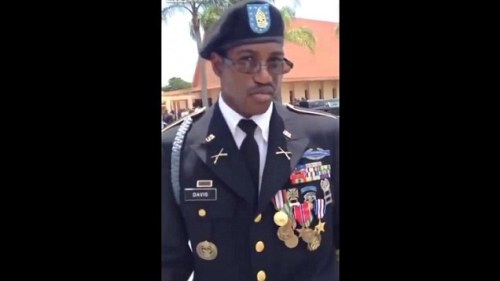
“But this Army Green Beret guy told me he’s carried a Hi-Point for years and never had a problem with it.”
- BUT LET’S MOVE ON TO SOMETHING NEAR AND DEAR TO MY HEART: SPARE AMMO.
For reasons I will never, ever, EVER understand, many gun carriers are convinced they’ll never need to reload. They carry their weapon with one mag in the mag well, and that’s it. “Well of course!”, they might say. “I carry a Glock 19 with a seventeen-round magazine, why would I need more than that?”
BECAUSE THINGS GO WRONG. Shooters in a gunfight shoot more and faster than they realize. Ammo fails. Magazines fail. Weapons double feed, requiring you to strip your magazine from the pistol, rack the slide several times, reinsert a mag and reload. Are you planning on stripping your mag from your weapon and taking the time to put it in your pocket, clearing your weapon, then taking the magazine back out (and maybe having to reseat or strip the top round because it’s sticking up vertically, as sometimes happens during double feeds) and then reloading, all while someone’s shooting at you? What if you’re running while clearing your weapon, how easy will it be to clear and reload with the same magazine?
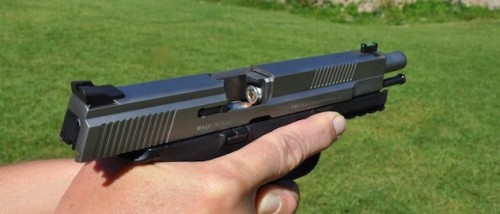
Double feed. Photo credit Dailycaller.com.
In real life, malfunctions happen even with the best of weapons. You can accidentally bang your pistol on a wall and unseat the magazine. You can induce a malfunction with an improper grip during a rushed draw. Or, far more likely, you can empty your weapon in seconds without realizing it (like the cop who shot a guy pointing a gun at me years ago; the officer thought he fired two or three rounds, when he had fired eight). Don’t be the guy who never thought he needed spare ammo, and died with an empty gun in his hand. That would be embarrassing.
Spare mags can be carried several ways, from belt pouches to mag holsters that clip to the inside of your pocket to carrying loose in a pocket. Respected tactical trainer Matt Graham taught me several years ago that pocket carrying mags works fine, and that’s what I’ve done since then. Others prefer different methods. However you do it, just do it.
One brief side note: if you get a small auto like a Glock 43 that only carries six rounds in a short magazine, remember that you only need ONE six-round mag. You might need that magazine in the gun for concealment, but your spare mags can have extensions to give you more ammo capacity. All my spare mags have +2 or +3 mag extensions from a reputable manufacturer. But whatever you do, don’t buy cheap mag extensions.
- THE CURSE OF THE “GET OFF ME GUN”
I’ve heard people say they just carry a “get off me gun” (GOMG). This is a weapon intended to just make an attacker stop his attack, not necessarily to incapacitate them. A Derringer, .25 Raven or any number of other small pistols are often referred to as GOMGs. People who carry them frequently don’t bother carrying spare ammo, and often say things like “I just plan on shooting it over my shoulder as I’m running away” or “It might not kill ‘em, but by god it’ll make ‘em quit coming at me.”
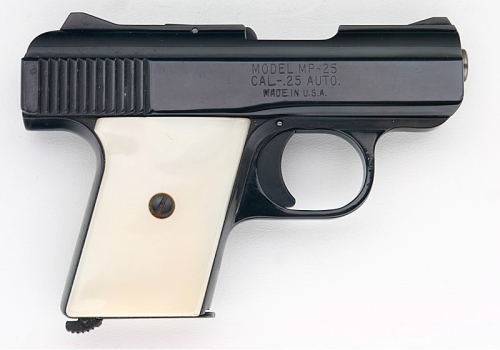
.25 Raven. Photo credit Auction Arms.
No it won’t. If you’re going to carry a gun, please, for the love of god, study the realities of gunfights. Determined attackers often take multiple hits and continue shooting, stabbing or punching. Even an unsurvivable wound might not kill someone for a while, as we saw back in the 1986 Miami FBI shootout where a robber/murderer took a lethal hit in the first few seconds of a fight but still managed to kill two FBI agents and wound several others before dying. Real life bullets don’t do what TV and movie bullets do, and if you think you’ll always drop someone with one dramatic shot you’re just wrong. GOMGs are typically underpowered with poor ballistic performance, and will likely be ineffective against someone high or drunk (or even just really mad, like one of the suspects in the FBI shootout).
Also, what if you’re not alone? The guy who plans on shooting as he’s running away seems to have failed to consider, oh, being robbed in the Wal-Mart parking lot while he’s with his wife and kids. Is he going to abandon his family and shoot over his shoulder while running away? Unfortunately, you don’t get to write the script for your gunfight. If you’re an armed citizen, any confrontation you have with a criminal is almost guaranteed to be an ambush where the criminal chose the time, location, and method of confrontation. You’ll already be on the defensive, don’t make it worse by carrying a GOMG with no spare ammo.
Again, there are situations where a GOMG is all you can get away with, and ya gotta do what ya gotta do. But for daily carry, I strongly recommend you carry a larger pistol you can actually fight with.
There are many, many more factors involved with carrying a gun, but I’ll stop here for now. If anyone has counter arguments to my points, please present them in the comments. I ain’t no expert on nuthin’, I’m always learning, and if I’m wrong about something I will gladly acknowledge my mistake. Thanks for reading, and if you’re going to carry a gun in public, please keep this in mind: a lethal force encounter is one of the most demanding, intense, complex situations anyone could ever face. If you’re untrained and get into a gunfight against an opponent with any skill whatsoever, you’re almost guaranteed to lose. So for yourself, your family and your fellow citizens, TRAIN WITH YOUR GUN.
—————————-
This post is dedicated to the memory of Kevin O’Brien, writer of the Weaponsman blog, who passed away unexpectedly last week. Kevin was a retired Special Forces Soldier, fellow Afghanistan veteran, true American patriot, genius about weapons, and hell of a nice guy. He enthusiastically supported my writing, and wrote the back cover blurb for my novel Line in the Valley. Kevin was taken from us far too soon, will be missed by many, and is hopefully enjoying the peace he truly earned. Rest in peace, brother.

Chris Hernandez (pictured above) is a 23 year police officer, former Marine and retired National Guard soldier with over 25 years of military service. He is a combat veteran of Iraq and Afghanistan and also served 18 months as a United Nations police officer in Kosovo. He writes for BreachBangClear.com and has published three military fiction novels, Proof of Our Resolve, Line in the Valley and Safe From the War through Tactical16 Publishing. He can be reached at [email protected] or on his Facebook page (https://www.facebook.com/ProofofOurResolve).
]]>
This one is about a new line of accessories for the Glock 43, my new favorite pistol:

http://www.breachbangclear.com/vickers-glock-43-accessories-from-tango-down/
This is my advice to prospective police applicants, especially veterans thinking of becoming cops:
“Thinking of Becoming a Cop? Please, For the Love of God, Read This First”
http://www.breachbangclear.com/thinking-of-becoming-a-cop-please-for-the-love-of-god-read-this/
This essay is about “auditory exclusion”, and how it may have contributed to the September Tulsa PD shooting, when Officer Betty Shelby killed an unarmed suspect who was high on PCP.
“The Reality of Auditory Exclusion”
http://www.breachbangclear.com/the-reality-of-auditory-exclusion/
This one is from before the election, about my utter disgust with both major candidates and what I’ll teach my sons about America.
“Raising Sons After the Apocalypse”
http://www.breachbangclear.com/raising-sons-apocalypse/
The next three were part of Breach Bang Clear’s “Tank Week”, celebrating the 100th anniversary of the tank’s appearance in combat.

“Syrian Lessons on Tank Warfare”
http://www.breachbangclear.com/syrian-lessons-on-tank-warfare/

“The Tanker’s Reputation, Born in World War I”
http://www.breachbangclear.com/the-tankers-reputation-born-in-world-war-i/

“RKG-3, The Russkie Anti-Tank Hammer”
http://www.breachbangclear.com/wtw-russkie-rkg-3-anti-tank-hammer/
I was also recently interviewed for a story about PTSD fraud. I thought the story turned out pretty well, except that the reporter for some reason thought my job in Iraq was to recover explosives. In Afghanistan one thing my HUMINT team did was gather intel for recovery of explosives, and I went on a couple recoveries myself, but in Iraq I was on a convoy escort team. The LAST thing I wanted to do in Iraq was meet any kind of explosive.

“Doctors Say VA’s Streamlined Claims Process Facilitating Fraudulent PTSD Claims”
On a side note, this is why I’m so outspoken about PTSD fraud. This douche Brandon Blackstone not only lied about being wounded and having a TBI in order to scam the VA and get free vacations (and a free house!), he also claimed to have saved the life of a real Marine who was badly wounded and later committed suicide. In reality Blackstone spent one month in Iraq, was sent home for appendicitis, and wasn’t in the wounded Marine’s vehicle like he said. But even after admitting he made up the Purple Heart and TBI stories, he’s STILL claiming PTSD.
Hope a few readers out there enjoy these essays, and I hope to have more time to devote to the blog soon. Cheers, guys.
Chris Hernandez is a 22 year police officer, former Marine and recently retired National Guard soldier with over 25 years of military service. He is a combat veteran of Iraq and Afghanistan and also served 18 months as a United Nations police officer in Kosovo. He writes for BreachBangClear.com and Iron Mike magazine and has published three military fiction novels, Proof of Our Resolve, Line in the Valley and Safe From the War through Tactical16 Publishing. He can be reached at [email protected] or on his Facebook page (https://www.facebook.com/ProofofOurResolve).
]]>Eating Tacos is Racist [The Deadly Scourge of Cultural Appropriation]
Chris Hernandez
You may have heard of the recent, tragic incident that horribly traumatized many innocent people. It made national news, disturbing video of it has been shared on social media, and it’s had an impact far beyond the people immediately involved. This incident and the evil behind it threaten to destroy the very fabric of our society.
What? No, not the latest terrorist attack. I’m talking about something far worse.
A white kid wore dreadlocks in college.

A white kid with dreadlocks! Run for your lives!
Yes, Cultural Appropriation has reared its ugly head in America. This white college kid had the gall, audacity, and White Privilege to steal dreadlocks from African culture (dreadlocks were also Egyptian, Viking, Greek, Spartan, Indian, Sufi Muslim, Aztec, and maybe even Jewish, but whatever). Despite the horror I’m sure you’re feeling, please muster the courage to watch the video. If you dare.
I know what you’re thinking: “That evil racist deserved far worse for what he did.” And many people agree, the white victim of harassment and assault was 100% to blame. Sure, maybe the black woman technically assaulted him, but come on. He appropriated her culture. And that’s unforgivable.
There have been other egregious instances of cultures being wrongly appropriated. Miley Cyrus dared to twerk. Coldplay and Beyonce made a video set in India. About 684,000 white celebrities pissed off Kareem Abdul-Jabar by wearing cornrows. Justin Bieber won the crown jewel of racism by wearing cornrows and dreadlocks. College students in the UK ordered gay men to stop stealing women’s culture by dressing in drag and acting like black women. A white couple stole black history by jumping a broom at their wedding, even though Europeans used to jump brooms at weddings too. And as another observer noted, the black male student in the above video appropriated Inspector Gadget culture.

Here’s a definition of Cultural Appropriation (CA), from racerelations.com:
“Taking intellectual property, traditional knowledge, cultural expressions, or artifacts from someone else’s culture without permission. This can include unauthorized use of another culture’s dance, dress, music, language, folklore, cuisine, traditional medicine, religious symbols, etc. It’s most likely to be harmful when the source community is a minority group that has been oppressed or exploited in other ways or when the object of appropriation is particularly sensitive, e.g. sacred objects.”
Notice the definition includes the terms “unauthorized use” and “without permission”; you see, if black people had told white people “It’s okay to have dreadlocks”, there wouldn’t have been an issue. And that’s where the entire silly, stupid, racist concept of CA falls apart, and the point I can’t even sarcastically pretend to take it seriously anymore.
Like many far-left ideas, CA requires us to stop thinking of people as individuals and instead lump them together by race or ethnicity. “All blacks/Mexicans/Koreans/whatever minority think white people need permission to use any symbols of their culture.” That’s pathetically stupid and overtly racist.
Read the rest at http://www.breachbangclear.com/cultural-appropriation/
Chris Hernandez is a 20 year police officer, former Marine and currently serving National Guard soldier with over 25 years of military service. He is a combat veteran of Iraq and Afghanistan and also served 18 months as a United Nations police officer in Kosovo. He writes for BreachBangClear.com and Iron Mike magazine and has published two military fiction novels, Proof of Our Resolve, Line in the Valley and Safe From the War through Tactical16 Publishing. He can be reached at [email protected] or on his Facebook page (https://www.facebook.com/ProofofOurResolve).
]]>
We aren’t blind to the past.
Yes, many Americans have suffered horrible, unforgivable racism. Some Americans continue to suffer today. Yet we two soldiers, one black and one Hispanic, chose to risk our lives for this country. We served in combat, alongside soldiers of other races, against an enemy who cared nothing of the color behind the American flags on our sleeves.
We didn’t do it because we believe America is perfect. We deal in brutal realities, and we know those realities. One of us grew up with a family legend about Texas Rangers executing a great-great grandfather and his brothers. One of us was introduced to racism by being a rare minority in a majority-white school, and dealing with racial epithets. One of us had his parents kicked out of a restaurant, while his father was serving in the military, because “we don’t serve your kind here.”
We acknowledge those sins. But we don’t believe, for a moment, that those sins define our country today. We refuse to poison our children’s minds with the lie that their race lessens their value as citizens, or restricts their boundless opportunities. We choose to embrace what we know to be right about America, rather than dwell on what was wrong.
Let’s discuss facts. Slavery was terrible. But no white person in America alive today owned or sold African slaves. Jim Crow was terrible. But most of those responsible for Jim Crow are dead, and those few who aren’t wield no power. Holding any white person today responsible for the wrongs of the past is not just illogical, it’s wrong and stupid. Redefining racism as “systemic,” effectively giving a pass even to those minorities who openly advocate murders of innocent whites, isn’t just wrong and stupid. It’s wrong, stupid, and pathetic.


You want to be considered equal? Then demand to be held to the same standard as whites. And live by that same standard.
Over fifty years after the 1964 Civil Rights Act, it is clear that race relations have regressed rather than progressed, particularly with racial subcultures who more often than not opt to self-segregate in cultural, political, and day-to-day fashions. Homogenization is the antithesis of American multiculturalism; America is about osmosis of culture, of appreciating and celebrating our differences while realizing we’re in the same boat and must work together to advance as a nation and a culture-at-large. People so focused on the past that they actively blame people today, for yesterday’s mistakes, are actively opposed to the American “melting pot.”
To that end, there are people, of multiple races, who seek to “erase” the past and its symbols. Those people should stop. Seeking to ban symbols one may not fully understand only serves to foment racial tensions and deepen the chasm.
One thing that actually closes that chasm is what we two authors have in common: military service. The military is one of the greatest mechanisms for making people realize we’re all Americans. The kind of people listed in the two paragraphs above would not fare well in the military, particularly if they were to work outside the wire (as we authors have). There is something about an enemy trying to kill you that hammers home a message: we’re all Americans of the same cloth and we must work together, not only for advancement, but for self-preservation. That may come off as a cavalier sentiment, but it is one to which any combat vet will attest.

Of course, there are several reasons why people join the military: family tradition, college benefits, thirst for adventure, what have you. But at the end of the day, it is rare that a veteran hangs up his uniform for the last time without a sense of patriotism. Regardless of their race or any other background factor, they come to appreciate that the sweat, blood, and tears they and their mates spilled counted for something greater than themselves.
The lessons learned patrolling dusty third-world streets and dodging gunfire in remote valleys carry over to civilian life. Those who fail to study the past are doomed to repeat it, but we should have more sense than to blame people in the here and now for mistakes of yesterday. We study those mistakes as a form of after-action review: how can we do better and move forward? That’s not just for blacks to move forward, or for Latinos to move forward, or whites, or Asians. We’re concerned with how Americans can move forward.
We’re concerned with how Americans can move forward because we believe in the principles established by the Founding Fathers. We believe in the right to life, liberty, and the pursuit of happiness. We believe in the rugged individualism embodied by our Constitution. We acknowledge that our government has not always abided by those principles in practice, but we know the American people, through the work of people like Dr. Martin Luther King, Jr. and Rosa Parks, have eventually held the government accountable to those promises.
We also fervently believe in defending what has been built, in defending the progress our nation has made. To that end, both authors have put on a uniform, picked up a weapon, and answered the nation’s call to service. We are not the first. The Japanese internment was one of our nation’s greatest mistakes, yet the Japanese-Americans of the 442nd Regimental Combat Team answered the call during the Second World War because they believed in the nation’s principles, even if the government failed to live up to them. Over nine thousand Purple Hearts, eight Presidential Unit Citations, and twenty-one Medals of Honor were awarded to the 442nd, a testament to the ferocity with which they defended their nation.
The 332nd Fighter Group (also known as the Tuskegee Airmen) also answered that call during the Second World War. At the height of Jim Crow these men opted to not only serve their country, but did so by breaking color barriers, proving that blacks were just as competent at dogfighting as their white counterparts.

A more recent example is Team 2/6, Company F, 51st Infantry LRP (Airborne), a Long Range Reconnaissance Patrol that consisted entirely of black men in Vietnam. In a time where the ghost of Jim Crow was still extremely strong and Muhammad Ali refused to serve because “no Viet Cong ever called [him] nigger,” these men not only answered the call but volunteered for Airborne and then for the LRRPs, one of the most dangerous combat roles in the Vietnam War. They believed in their nation and believed in defending it and its principles from the enemy, even as the nation struggled to live up to those principles.

Our nation has made many mistakes in the past, some minor and some grievous. We can acknowledge mistakes made and still love this country. Unlike the “blame America first” crowd, we know our nation has done more good than harm. We love our nation. We love the principles upon which it was founded. We embrace the amazing accomplishments of previous generations, and stand on the shoulders of those who came before us.

Hernandez with Mr. Richard Overton, America’s oldest known WW2 veteran
So here’s our message to America’s grievance merchants: while you’re busy with your desperate quest to find racial offense, we two are busy living happy, fulfilling lives with fellow Americans of all races…even white ones whom you automatically consider evil.
We are certain some will view us as Uncle Toms or “sellouts to the white man” for our opinions, for daring to think for ourselves, for the stark offense of being Americans first and color-indifferent rather than aligning on racial fault lines. To those people, in closing, we have a quote:
“We must not seek to use our emerging freedom and our growing power to do the same thing to the white minority that has been done to us for so many centuries. Our aim must never be to defeat or humiliate the white man. We must not become victimized with a philosophy of black supremacy. God is not interested merely in freeing black men and brown men and yellow men, but God is interested in freeing the whole human race. We must work with determination to create a society, not where black men are superior and other men are inferior and vice versa, but a society in which all men will live together as brothers and respect the dignity and worth of human personality.”
Did you find yourself saying that the quote must be from an Uncle Tom sellout?

It’s from Dr. Martin Luther King, Jr., a man who endured more hardship and injustice than anybody claiming grievances in the here and now. Dr. King obviously felt that racial supremacy was wrong, and humans banding together for self-betterment was the answer.
We two authors have chosen to band together for self-betterment. Others, of all races, have chosen the path of the racial supremacist. If the racist shoe fits, wear it. But don’t expect us to believe you want fairness, equality, or progress.
Authors:

Chris Hernandez is a 20 year police officer, former Marine and currently serving National Guard soldier with over 25 years of military service. He is a combat veteran of Iraq and Afghanistan and also served 18 months as a United Nations police officer in Kosovo. He writes for BreachBangClear.com and Iron Mike magazine and has published two military fiction novels, Proof of Our Resolve and Line in the Valley, through Tactical16 Publishing. He can be reached at [email protected] or on his Facebook page (https://www.facebook.com/ProofofOurResolve).


Steven Hildreth, Jr. is an author, Iraq War veteran and firearms enthusiast who has written for Ranger Up’s Rhino Den and the Force 12 Media Network. He resides in Tucson, Arizona.
]]>————————————-
So there I was, finger on the trigger, stock in my shoulder, left hand on the monopod adjustment, staring through a scope at a thousand yard target. And our instructor, that bastard, didn’t just want me to hit the target. He wanted me to hit its head. Everyone knows thousand-yard head shots only happen in bad novels and action movies.
This was on day two of 1MOA Solutions’ (1moasolutions.com) Precision Rifle Course, held at Red Stag Tactical’s range in Eagle Lake, Texas. When I heard about the class I got all excited at the prospect of making long-distance shots like I had in Afghanistan. The problem was, I don’t own a good long-distance rifle. So my options were borrow whatever I could get, or take my WWII Enfield to the course.
I borrowed an AR-10 clone from an Army buddy. It had a badass new Trijicon scope on top; unfortunately, it was a badass Trijicon scope with a hunting reticle, no mil or MOA lines. And I only had 75 match rounds instead of the required 200, the rest was whatever craptastic ammo I could find at Academy. So while I expected to learn a lot at the course, my personal performance expectations were low. I figured I’d be able to hit out to 600 or so, and would watch other shooters hit at a thousand. I was just there to have a good time.

Day one, zeroing
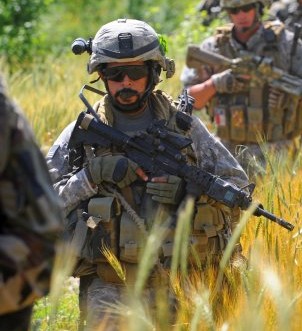
The other students were all civilians with no military background. I was the only one who had been downrange, been shot at, and shot at people. That DID NOT mean I was the most skilled or well-trained shooter. I went through Marine boot camp, picked up a secondary MOS of range coach (8531) and fired expert six times during my enlistment. In the Army I was lucky enough to attend the Squad Designated Marksman course and fire to 600 yards with M16A4s using optics and irons. In Afghanistan I was able to hit at 900 meters with my M14 and at 980 meters with a French .50 once. So yeah, I had some experience.

Firing a PGM .50 French sniper rifle in Afghanistan, with a French Marine sniper talking me on
But I didn’t have a good grasp on the science behind long-distance accuracy. I had never used a Kestrel or other small arms ballistic computer (although I was familiar with the basics from my time as an Abrams tank gunner). As far as rifles went, I had pretty much been spoon fed whatever the Corps or Army wanted me to know, which wasn’t much more than the basics. In Afghanistan I was able to make long distance hits on static targets, always under ideal conditions, usually with French snipers talking me on.
But in this class I was going to have to get way in depth on accuracy. On that first day Adam sat at a table with us, passed Kestrels around and talked us through ballistic calculations. Two students were engineers, had really studied ballistics and had a level of knowledge way over my head. They and Adam had an intense, hard-to-follow discussion about mil versus MOA adjustments, G1 versus G7 scales and the ballistic coefficient of a laden swallow; my contribution to the discussion was something to the effect of “I like tacos.” If I had any illusions about my mastery of shooting, I lost them at that table.
So I went into the class with an open mind and tried to stay humble. And I learned a LOT. And shot far better than I expected. This two-day class consisted of a short period of classroom instruction on ballistic calculations, zeroing at 100 yards, a few accuracy drills at 100 yards, range estimation class, unknown distance engagements on steel targets, known distance engagements on steel to 1000 yards, unconventional position training, and a short discussion on useful accessories.
We had one slight problem: rain. No offense to the townsfolk, but Eagle Lake only has that name because “Buzzard Swamp” was taken. Heavy rain drenched the area for weeks before the class and the first day was a partial washout. Because we lost valuable range time we had to give up the planned range estimation class. The rain also flooded roads, prevented placement of some targets, got trucks stuck and created a pool deep enough to trap a tractor and nearly drown Adam Wilson (from the tower several hundred yards away we saw him standing on the tractor bumper singing “The heart will go on” while the driver yelled “I’ll never let go!”). That all sucked, but 1MOA and Red Stag are making up for the lost instruction time at a later date.
The instruction we did receive, however, was friggin’ fantastic. Here’s what I learned: The right gear makes a huge difference. Prior to this class I thought my Afghanistan M14EBR was the One True Rifle. I expected my borrowed AR-10 to be decent, nowhere near as good as a 14.
Then Adam Wilson looked through my AR-10 scope and said, “This isn’t going to work. Use one of my rifles.” And he handed me his Ashbury Precision Ordnance Tactical Competition Rifle in 6.5 Creedmoor with a Surgeon action and Leupold Mk 8 3.5 – 25 x 56mm scope. It was kind of like telling a high school boy, “Your prom date is just so-so. Here’s Sasha Grey, take her instead.” I’ve never handled a rifle that accurate, and my eyes have been opened. A 7.62 anything just isn’t as accurate as a good 6.5; we had one 7.62 shooter, and as predicted he just couldn’t make the same shots a 6.5 shooter could (although he did hit at a thousand).
Shooting a precision rifle is a lot different than firing a carbine. Duh, right? Don’t get me wrong, the principles are the same. But little things make a huge difference. For example, during CQB-type carbine training we’re death-gripping our weapons. At SDM school I’m pretty sure I did the same thing. But in this course we learned to not strangle the pistol grip. In fact, Adam had us lightly hold the grip with just three fingers, without even wrapping our thumb around it. One student barely even touched the pistol grip; just about the only part of his strong hand touching the weapon was his trigger finger. And he was accurate to a thousand yards.
To be a good distance shooter, you might have to shotgun breach a tree. WTF do I mean by that? Well, when we were on the known distance range we fired at 300, 500, 700 and 1000 yards. Everyone hit at 300 and 500 with no problem. Then one student was nowhere near the target at 700. Adam couldn’t spot his trace or see a splash, so he had the next shooter try it. That shooter hit. Then I tried 700, and again, Adam couldn’t tell where the hell I was hitting. We went back to the first shooter. I was watching through my scope when he fired; I heard his rifle go boom, a small branch fluttered down and his round splashed into the mud far short and far right of the target.
I hadn’t paid much attention, but a few branches were hanging over the range. I thought they were too high to make a difference, and I had that tanker mentality about brush anyway: “Brush? Who cares? Just shoot through that shit!” Well, you can’t just shoot through that shit. Even light brush can totally jack your mojo. I wound up riding in a tractor bucket onto the range and blowing the branches down with a shotgun. Maybe someone thought that would remind me of my glory days on a tank. No, they didn’t make me do the gardening because my last name is Hernandez. I swear.
Read the rest at http://www.breachbangclear.com/1moa-solutions-precision/
Chris Hernandez is a 20 year police officer, former Marine and currently serving National Guard soldier with over 25 years of military service. He is a combat veteran of Iraq and Afghanistan and also served 18 months as a United Nations police officer in Kosovo. He writes for BreachBangClear.com and Iron Mike magazine and has published two military fiction novels, Proof of Our Resolve and Line in the Valley, through Tactical16 Publishing. He can be reached at [email protected] or on his Facebook page (https://www.facebook.com/ProofofOurResolve).
http://www.amazon.com/Line-Valley-Chris-Hernandez-ebook/dp/B00HW1MA2G/ref=pd_sim_kstore_1?ie=UTF8&refRID=09XSSHABSWPC3FM8K6P4
http://www.amazon.com/Proof-Our-Resolve-Chris-Hernandez-ebook/dp/B0099XMR1E/ref=pd_sim_kstore_1?ie=UTF8&refRID=0S6AGHBTJZ6JH99D56X7
People of several different races are having a public event. Two people of one specific race show up to cover the event. Someone at the event says, “We don’t want that race here.” The two race-offenders are escorted out of the event, despite the fact that they had personally done nothing wrong. They were journalists, and were kicked out of the event simply because of their skin color.
Now let’s say there was a backlash. The event organizers took some heat for barring one race from the event. You might think the event organizers would apologize, promise sensitivity training, insist the two people were kicked out because of one person’s mistake instead of any discriminatory policy, and claim the entire thing was just a misunderstanding. Or maybe they’d immediately fire/exile/expel/charge whomever kicked people out because of their race. Isn’t that what always happens when an organization does something blatantly racist?

ryersonian.ca
In this case, no. This event was at Canada’s Ryerson University, hosted by the Racialised Students’ Collective (and the mentality displayed by the “Racialised Students” would be at home on any number of American universities). The people kicked out were white journalism students. So no harm, no foul, no widespread outrage.
http://www.ryersonian.ca/white-students-barred-from-funded-rsu-student-group-event/
It gets better than that. Shortly after the somehow-not-racist-event, the Huffington Post published an essay from Ryerson journalism student Aeman Ansari titled “Ethnic Minorities Deserve Safe Spaces Without White People”.
http://www.huffingtonpost.ca/aeman-ansari/ethnic-safe-spaces_b_6897176.html
In her essay, she makes a few interesting points:
“These [safe] spaces, which are forums where minority groups are protected from mainstream stereotypes and marginalization, are crucial to resistance of oppression and we, as a school and as a society, need to respect them… Segregation was imposed on people of colour by people of privilege, not the other way around. The very fact that individuals organizing to help each other get through social barriers and injustices are being attacked and questioned for their peaceful assembly is proof that they were right to exclude those [white] students… Racialized people experience systemic discrimination on a daily basis, on many levels, and in ways that white people may never encounter. The whole point of these safe spaces is to remove that power dynamic.”
She also says, “I am a person of colour and a journalist and so there are two conflicting voices inside my head. But in this case one voice, that of a person of colour, is louder and my conscience does not allow me to be impartial. I have to take a side.” This is a sentiment I strongly suspect many journalists with “social justice” indoctrination share. Perhaps that’s why they shy away from any story that might reinforce negative stereotypes about a minority, yet embrace any story that portrays whites as racist. “Hands up don’t shoot”, anyone?
As a minority and supposed “person of color” (if I ever actually use that phrase to describe myself, please punch me), I guess I should be thrilled that my fellow coloreds are now free to put white people in their place. I should cheer the Racialised Students and embrace my dark-skinned sister for being courageous enough to accuse – in the Huffington Post, where blatant racial pandering is never welcome (yuk yuk) – all white people of being oppressors.
Long live the revolution. Kill whitey. Power to the people. Four hundred years of oppression. Whoop.
But I just ain’t feelin’ it. Maybe I wasn’t oppressed enough as a child; I grew up in Texas, “the America of America”, in a mixed white and Hispanic neighborhood. I was around whites all day every day. We played, went to school, and grew into adulthood together. I’m obviously Hispanic, but somehow was never oppressed by whites (or maybe I just didn’t notice). At seventeen I joined the Marines and served with men and women of all colors, but most were white. As a cop I’ve risked my life with and for whites, and whites have risked their lives for me (likewise with blacks, Asians and others). As a soldier in Iraq and Afghanistan I experienced the same thing.
Were some whites I knew racist? Of course. So were some blacks. So were some Hispanics. My parents were discriminated against, as were my grandparents. One family story even had the Texas Rangers murdering my great-great-grandfather and his brothers in retaliation for one of Pancho Villa’s raids. If the story is true, I’m pretty sure the Rangers who committed the murders are dead, as are most of the people who discriminated against my parents and grandparents. The country has changed, for the better.
I embrace that change. I see Americans of all colors treating one another as equals every day. And I heard of this guy once, who said something like, “Don’t be a dumbass and judge someone just because of what color they are.” That actually applies to whites too, not just supposedly oppressed minorities.
And whites shouldn’t be viewed as the world’s only oppressors. Slavery among blacks was so common in Africa it remained legal in Nigeria until 1932, in Ethiopia until 1942, in Niger until 2003 and in Mauritania until 2007; even now a huge portion of Mauritania’s population is still believed to be slaves. Black Africans were heavily involved in capturing and selling slaves, and some historians estimate “… Africans captured and then sold to Europeans around 90% of those who were shipped in the Atlantic slave trade” (http://en.wikipedia.org/wiki/Slavery_in_Africa).
Here in America, where our default is “whites were slave owners, blacks were slaves and that’s the end of it”, free blacks owned slaves as far back as 1654. Free black slave owners in Louisiana even requested, and were granted, permission to serve in the Confederate Army (http://www.theroot.com/articles/history/2013/03/black_slave_owners_did_they_exist.html). And Arabs, now automatically considered oppressed, were well-known and enthusiastic slave traders for centuries. Here’s just one example: “Periodic Arab raiding expeditions were sent from Islamic Iberia to ravage the Christian Iberian kingdoms, bringing back booty and slaves. In a raid against Lisbon in 1189, for example, the Almohad caliph, Abu Yusuf Yaqub al-Mansur, took 3,000 female and child captives, while his governor of Córdoba, in a subsequent attack upon Silves in 1191, took 3,000 Christian slaves” (http://en.wikipedia.org/wiki/Arab_slave_trade).
Native Americans, our most revered “peaceful” population, weren’t always so peaceful and non-oppressive either. I’m not just referring to Native American attacks on whites: “…among the indigenous peoples of the Americas, only 13% did not engage in wars with their neighbors at least once per year. The natives’ pre-Columbian ancient practice of using human scalps as trophies is well documented. Iroquois routinely slowly tortured to death captured enemy warriors… at Crow Creek in South Dakota, archaeologists found a mass grave containing the remains of more than 500 men, women, and children who had been slaughtered, scalped, and mutilated during an attack on their village a century and a half before Columbus’s arrival (ca. 1325 AD).” (http://en.wikipedia.org/wiki/War_Before_Civilization)
With this historical context, how does anyone arrive at the “white = oppressor, nonwhite = victim” conclusion so beloved by Aeman Ansari and Ryerson’s Racialised Students? Maybe I’m breaking the inviolable Oppressed Minority Code of Silence by saying this, but every race has its share of historical horrors. White people shouldn’t defined by past slave ownership any more than African blacks should be.
I’d also like to point out an inconvenient fact: If all white people are evil because of slavery, then all white Americans are heroes for ending it.
Maybe I’d be the only person on the typical University campus who’d know this, but in America we actually fought a really bad war to end slavery. Over 350,000 white Americans died fighting to end slavery. White Americans burned white American cities to the ground to end slavery. White Americans completely destroyed other white Americans’ ways of life and forced them to abandon slavery. American slaves weren’t powerful enough to rise up and free themselves; white people freed them. Why do whites seem to get all the blame for historical oppression, but none of the credit for fighting it?
Yes, I realize it’s pathetically stupid to credit all whites for the actions of those who fought to end slavery. And it’s just as stupid to condemn all whites for the actions of those long dead. I’m not saying all white people are great; plenty are absolutely scumbag (I’ve arrested a LOT), and many are racist. But those people should be judged on their own merits. Am I wrong to view whites, or anyone else for that matter, as individuals who should be judged as individuals?
When I was in Kosovo I had a conversation with a local about her ethnic enemies. “The adults commit crimes against us. The old ones used to, and the young ones will someday. So they should all be killed, from one until the end.” It was a stupid, destructive mindset that always, always, does horrible damage to those who hold it. In modern America, and Canada, everyone should reject the notion that all people of any race are the same. Or that we need to keep any race out of our “safe spaces”.
Oddly enough, this is one thing I loved about being in combat; under fire, you are who you are. Nobody cares about race. All that matters is whether or not you can do your job and cover your brothers’ and sisters’ backs.
On its website, the Racialised Students’ Collective says it “…opposes all forms of racism.” Then it excludes students for being white. I’m sure the Racialised Students don’t see the irony in that. Aeman Ansari, I’m sure, tirelessly campaigns against racism. Then she supports keeping white students away from minorities, because a white person’s mere presence allegedly makes them unsafe. I’m sure she sees no irony. The Huffington Post published Ansari’s essay praising racism against whites, then added a slideshow to the page showing “9 people who think casual racism is okay.” But they didn’t add Ansari or the Racialised Students to the slideshow.
The Huffington Post probably doesn’t see the irony either.
Chris Hernandez is a 20 year police officer, former Marine and currently serving National Guard soldier with over 25 years of military service. He is a combat veteran of Iraq and Afghanistan and also served 18 months as a United Nations police officer in Kosovo. He writes for BreachBangClear.com and Iron Mike magazine and has published two military fiction novels, Proof of Our Resolve and Line in the Valley, through Tactical16 Publishing. He can be reached at [email protected] or on his Facebook page (https://www.facebook.com/ProofofOurResolve).
http://www.amazon.com/Line-Valley-Chris-Hernandez-ebook/dp/B00HW1MA2G/ref=pd_sim_kstore_1?ie=UTF8&refRID=09XSSHABSWPC3FM8K6P4
http://www.amazon.com/Proof-Our-Resolve-Chris-Hernandez-ebook/dp/B0099XMR1E/ref=pd_sim_kstore_1?ie=UTF8&refRID=0S6AGHBTJZ6JH99D56X7
—————————————————-

We’re losing the fight against Stolen Valor. It seems like every week we hear a new military poser story, involving a range of people from homeless bums to senior politicians. Many veterans, myself included, have personal stories of poser encounters. Web sites like Guardian of Valor and This Ain’t Hell continually expose egregious Stolen Valor cases, and aren’t likely to run out of story subjects within my lifetime.
Here’s evidence of how bad the problem is: approximately 3,400,000 Americans served in Vietnam, off its coast or in the Vietnam Theater. But according to the National Vietnam Veterans Foundation, nearly fourteen million have lied about serving in Vietnam. “During [the year 2000] Census count, the number of Americans falsely claiming to have served in-country is 13,853,027. By this census, FOUR OUT OF FIVE WHO CLAIM TO BE Vietnam vets are not.” (http://www.nationalvietnamveteransfoundation.org/statistics.htm)

The scope of the Stolen Valor problem is enormous. I think there are two main reasons why. First, so few Americans today know anything about military service that tricking them with unbelievable war stories is ridiculously easy. And second, fewer and fewer Americans care at all about military honor or integrity.
Military lies are easy to pull off
Last year I met an old Army buddy, Dave, for dinner. We were friends before deploying and later served in the same company in Iraq. He did two notable things in Iraq: after his convoy was ambushed and stopped one night, he ran around in the open under fire trying to get it moving again. And he – literally – dug up an Improvised Explosive Device with his bare hands during a patrol.
The IED thing deserves explanation. While patrolling Dave saw wires leading to a pile of trash beside the road. He called it out and moved up to investigate, but wasn’t certain it was an IED.
“They always told us not to waste EOD’s time with false IED reports,” Dave said. “I figured I better make sure it really was one before I called it in.”
He dug into the trash and saw the wires going into the dirt. So he dug into the dirt until he found an artillery shell. But it wasn’t connected to the wires, so he kept going until he uncovered a second one. Wires were going into this one. He finally stood and announced, “It’s an IED!”
Dave told me about it a few days later. Long before he finished the story, I interrupted him with “WHAT THE FUCK COULD YOU HAVE POSSIBLY BEEN THINKING?” I was sure some frustrated insurgent had been screaming “Allah dammit!” while watching him and furiously touching a wire to a car battery.
So last year when I met Dave for dinner, an old high school friend joined us. My high school buddy was a Navy veteran who served in the 90s. When he sat down, I introduced them.
“Joe, meet Dave. We served in Iraq together. He’s all messed up because an IED went off in his helmet. He would have been okay, but a secondary went off on the other side.”
Dave burst out laughing. I joined him. But my high school friend flinched, waited for the laughter to die and quietly asked, “Are you doing alright now?”
My high school friend is no dummy. He’s an educated, intelligent professional, and is involved in organizations and activities that support veterans. He just didn’t get our Army humor, and because he never served in Iraq he didn’t know how ridiculous the IED-in-the-helmet joke was.
A Navy veteran was that easy to trick, if that had been our intent. How easy do you suppose it is to trick someone who knows nothing of the military?
Read the rest at http://www.breachbangclear.com/stolen-valor-is-no-big-fucking-deal/
Chris Hernandez is a 20 year police officer, former Marine and currently serving National Guard soldier with over 25 years of military service. He is a combat veteran of Iraq and Afghanistan and also served 18 months as a United Nations police officer in Kosovo. He writes for BreachBangClear.com and Iron Mike magazine and has published two military fiction novels, Proof of Our Resolve and Line in the Valley, through Tactical16 Publishing. He can be reached at [email protected] or on his Facebook page (https://www.facebook.com/ProofofOurResolve).
http://www.amazon.com/Line-Valley-Chris-Hernandez-ebook/dp/B00HW1MA2G/ref=pd_sim_kstore_1?ie=UTF8&refRID=09XSSHABSWPC3FM8K6P4
http://www.amazon.com/Proof-Our-Resolve-Chris-Hernandez-ebook/dp/B0099XMR1E/ref=pd_sim_kstore_1?ie=UTF8&refRID=0S6AGHBTJZ6JH99D56X7

Last week I attended an “ISIS in America” presentation. It was hosted by a local university for a law enforcement audience, but was open to the public. Making the event a free-for-all was a bad idea; a few people on personal crusades showed up just to pitch their causes. For example, at one point a woman stood up to tell the crowd, for no apparent reason, about her quest to change Texas textbooks.
The event organizer was a retired army officer turned college professor. Most of his talk was a litany of right-wing talking points, delivered to an extremely receptive audience. I found myself annoyed. I actually agreed with many of his comments, but like to think I have a deeper understanding of the reasoning behind them. His speech was more “We need to bomb ISIS!” followed by cheers, rather than in-depth explanations of how incredibly difficult this problem is to solve.
Then the first guest speaker arrived. He was an American Muslim who converted in the 1960s, now a professor of Muslim history. He gave a very interesting, insightful presentation about Islam’s history, and some of the factors that led to ISIS’s creation. He emphatically condemned ISIS, clearly stated the Muslim world needed to defeat ISIS, and joked “Islam would be perfect, except for Muslims.” He mentioned the recent execution of the Jordanian pilot and pointed out Islam does not condone burning prisoners.

I was very impressed with his speech. So were the people I was with. The police officers in the room stayed quiet. But, of course, someone had to make a show of challenging the professor.
A tall older man in a suit, apparently not a cop, stood and walked to the professor with a book in hand. He asked in a loud, bombastic voice, “Professor, are you familiar with this book? This is a biography of the Prophet Mohammed, written hundreds of years ago!”
The professor said he had heard of the book. The man asked, again in a loud voice, “Would you agree, professor, that this is an accurate representation of Mohammed’s life?”
The professor said he hadn’t read it.
The man announced, “Allow me to point out this passage!” And he told a story of Mohammed setting a fire on a Jewish prisoner’s chest to make him reveal where he’d hidden valuables.
The professor calmly explained that not all Muslims accept the biography as true, and that it’s not a source of religious law. He said that even if the story was true, that didn’t mean Islam condoned burning prisoners. The professor badly stepped on his crank at one point – “If Mohammed did that, he didn’t do it often,” which drew laughter from the audience – but he clearly explained that despite the biography’s claim, Islam does have rules governing treatment of prisoners.
After the grandstanding man finally sat back down, an elderly woman confronted the professor about Islam’s treatment of women and non-Muslims. The professor, of course, defended Islam’s racial inclusiveness. But he also admitted it has problems. “Islam does have a room for improvement when it comes to equality.”
The woman made a comment about crimes committed by radical Muslims. Then she turned to the audience and sneered, “The ‘religion of peace.’”
When the host shut down questions, another man actually put an “infidel” t-shirt on, over his long-sleeve button-down collared shirt, and tried to approach the professor. He didn’t get a chance, because someone else was already there asking why “all the different sects like Sunni, Shiites and Kurds” – not understanding Kurds aren’t a sect – “are killing each other.”
I listened with growing disgust. Yes, I despise radical Islam. I’d personally napalm every ISIS fighter if I could. And I’m agnostic, no fan of religion in general. But I’ve lived and worked with Muslims in Kosovo. I’ve fought beside Muslim soldiers in Afghanistan. I’ve helped a Muslim friend write a novel. I’ve taken a Muslim friend from Libya to the shooting range. Two months ago I attended a murder mystery party hosted by a friend originally from Lebanon; my wife and I mingled with white, black and Arab guests all dressed in 1920’s flapper and gangster costumes (and at any party hosted by an Arab, the food is awesome).

With two Afghan Army officers in Kapisa province, 2009. The soldier in green coveralls was thirty-five then, and had been fighting continuously since age fifteen. I went on many mission with him.
The Muslims I’ve known and served with had nothing in common with ISIS, despite the fact that they share the same religion. Just like my Christian parents have nothing in common with the Westboro Baptist Church. I can hate the WBC without hating all Christians. And I can hate radical Islam without hating all Muslims.
ISIS is in fact Islamic, as The Atlantic explained in a fantastic recent article (http://www.theatlantic.com/features/archive/2015/02/what-isis-really-wants/384980/). So were the Afghan troops I served beside. So were my Albanian friends in Kosovo. So are many of my American friends. ISIS wants a return to the caliphate of Mohammed’s time, and believe in following every Islamic law to the letter. The Muslims I’ve known have been, to say the least, different.
Many Afghan soldiers really liked American girly magazines, and alcohol. An Albanian friend in Kosovo explained, “Yeah, I’m Muslim and all that. But if you follow all the Muslim rules you can’t drink, can’t smoke, can’t have sex, can’t do anything. I’m not going to live like that.” A Muslim fellow police officer in Texas echoed that sentiment. “You know Catholics who go to church twice a year, on Christmas and Easter? That’s how Muslim I am.” A former Afghan translator I served with in Afghanistan, who now lives in Texas, is so incensed by ISIS’ acts in the name of his religion he wants to join the Peshmerga and kill them. I know Muslims who are devout and observant, and still have nothing in common with ISIS.
I might also mention that the Kurds, who are heroically resisting ISIS, are Muslim. So are the Muslim Jordanians. I’d venture to say Jordan’s King Abdullah commands more respect among soldiers and marines than our own president.


I can hate ISIS without hating all Muslims. I can acknowledge the blindingly obvious – ISIS is Islamic – without believing all Muslims are like them. While there is obviously something in Islam which convinces far too many of its followers they’re justified in committing the most inhuman acts imaginable, far larger numbers of Muslims reject ISIS’ actions.
We in the west often say the Muslim world needs to strongly condemn ISIS. Then we have Muslims who do condemn them, like the professor. And they’re willing to do so out loud, in public, to an audience of non-Muslims. They should be applauded for that. Instead, some are challenged and ridiculed by morons using their ignorance to prove a flawed point.
Plenty of Muslims are good guys. We’re fighting on the same side, against a common enemy. When Muslim good guys condemn Muslim bad guys, let them. Support them. Stand with them. Don’t insult and berate them, simply because you can’t tell the difference between good ones and bad ones.
Chris Hernandez is a 20 year police officer, former Marine and currently serving National Guard soldier with over 25 years of military service. He is a combat veteran of Iraq and Afghanistan and also served 18 months as a United Nations police officer in Kosovo. He writes for BreachBangClear.com and Iron Mike magazine and has published two military fiction novels, Proof of Our Resolve and Line in the Valley, through Tactical16 Publishing. He can be reached at [email protected] or on his Facebook page (https://www.facebook.com/ProofofOurResolve).
http://www.amazon.com/Line-Valley-Chris-Hernandez-ebook/dp/B00HW1MA2G/ref=pd_sim_kstore_1?ie=UTF8&refRID=09XSSHABSWPC3FM8K6P4
http://www.amazon.com/Proof-Our-Resolve-Chris-Hernandez-ebook/dp/B0099XMR1E/ref=pd_sim_kstore_1?ie=UTF8&refRID=0S6AGHBTJZ6JH99D56X7