The new lieutenant heard about the work my team did, and when we met he said, “I really hope I get to go on some missions with you guys.”
It just so happened we were scheduled to go on a mission with French Marines the next day. “That’s a good idea, Lieutenant,” I said. “Why don’t you come out with us tomorrow? Since the French have a separate radio network, you can ride in the French company commander’s vehicle with an American radio and relay our traffic to him.”
The lieutenant’s eyes lit up. “You think I could do that?”
“Hell yes. All you have to do is get permission from your boss, borrow a radio from someone, and ask the French commander if he’d like to have you along.”
The lieutenant enthusiastically promised he’d do those things. I told him I’d find him later to help him prepare for the mission. He walked away excited.

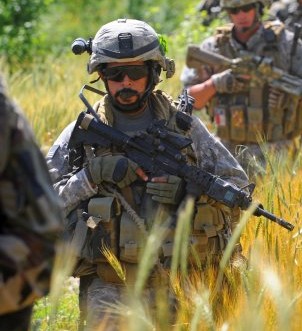
French troops patrolling the Afghanya Valley, Kapisa Province. Photo by Thomas Goisque (www.goisque-photo.com).
Several hours later I saw him again. “Hey sir,” I asked, “you all ready for tomorrow?”
He glumly shook his head. “Uh, no, sergeant. I didn’t know who to get a radio from.”
I gave him a what the f**k look. “Dammit LT, come with me.”
I dragged him to the American Counter-IED Team. “You guys have a radio the lieutenant can borrow?”
The team’s sergeant tossed him one. “Sure thing. Just bring it back when you’re done.”
I turned to the lieutenant and asked, “Did you get permission from your boss?”
He sheepishly shook his head. “Um… I didn’t know if I should ask, since I just got here.”
“Dammit, lieutenant!”
I dragged him to his major, inside the firebase command post. “Sir, can your new LT come with us on the mission tomorrow?”
“No problem. Make sure he doesn’t get hurt.”
We walked outside. Even though I knew the answer, I asked the lieutenant, “Did you talk to the French commander?”
The lieutenant gave me a whipped puppy look and shook his head.
“Dammit, lieutenant!”
I pulled him along to the French company command post. “Hey sir,” I told the French captain. “We have a new intelligence lieutenant. Can he ride in your vehicle tomorrow and be your radio liaison?”
The French captain nodded. “Oui. But of course.”

French engineers clearing the road in front of a French VAB (amphibious armored vehicle)
I pulled the lieutenant out of the command post. His eyes were downcast. I asked, “Lieutenant, what the hell? You said you wanted to go on the mission. Are you scared to go, or what? If you don’t want to go, just say so.”
The lieutenant shook his head vigorously. “Sergeant, I’m not scared! That’s not the problem. It’s just that… well, I’m nervous. I mean, what if we get into a firefight, and I give a wrong order and get someone hurt or killed? I’m just scared of telling someone to do the wrong thing.”
I gave him a serious look. “Lieutenant. You don’t have to worry about giving a bad order tomorrow. You’re a new lieutenant, new in country. If we get into a firefight, and you give an order, nobody will listen to you. So don’t worry about it.”
The lieutenant looked stunned; for a second or two, he was actually speechless. Then he gathered himself, and said, “Uh… okay. In that case, I guess I’ll go.”
He went out with us the next day. And we got into a firefight. The Taliban opened fire on French vehicles as the team I was attached to scrambled down a mountainside. A burst of machine gun fire barely missed a French forward air controller as he stuck his head out of my vehicle. French gunners dumped thousands of .50 and 7.62 rounds back at enemy-occupied compounds. At one point, an RPG flew between the lieutenant’s vehicle and mine as we rolled down a road (I’ll never forget the look on his face when he described watching it zip past). It was a hell of a first mission for a new lieutenant.
It was also his last mission. When we got back to base, his boss told him he couldn’t go out again because it was too dangerous. So he got to go outside the wire one time, and earned a real Combat Action Badge for it.
And I like to think I taught him something important. Just because the book says “the officer is in charge and everyone of lower rank must follow his orders”, real life says “if you don’t know what the hell you’re doing the best thing to do is shut up and listen to those who do”. That applies to all of us in the military who call ourselves leaders. Including me.
Chris Hernandez is a 20 year police officer, former Marine and currently serving National Guard soldier with over 25 years of military service. He is a combat veteran of Iraq and Afghanistan and also served 18 months as a United Nations police officer in Kosovo. He writes for BreachBangClear.com and Iron Mike magazine and has published two military fiction novels, Proof of Our Resolve and Line in the Valley, through Tactical16 Publishing. He can be reached at [email protected] or on his Facebook page (https://www.facebook.com/ProofofOurResolve).


 ]]>
]]>————————————
Signs, Of Veteran Entitlement
I won’t go into too much detail, since I’m sure most of you have heard of this already. But apparently some veterans are so traumatized by their wartime service they’re asking people to “be courteous with fireworks” around their homes on July 4th. Because fireworks “trigger” their PTSD.
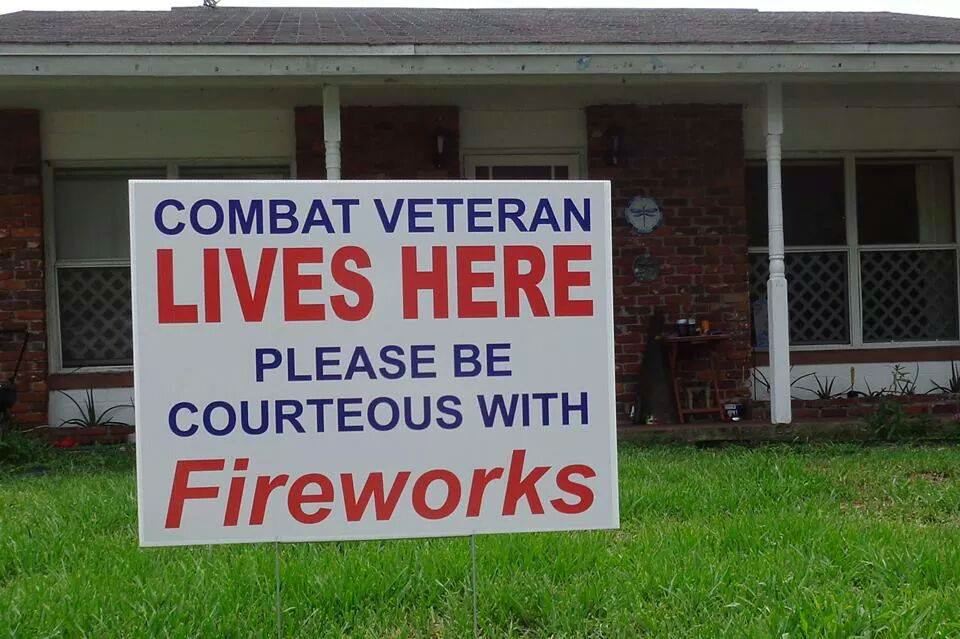
These signs are being popularized by an organization called “Military with PTSD”, which according to CNN has sent the signs to 2500 veterans and has 3000 more on a waiting list. According to the organization’s founder, the signs aren’t intended to make people stop using fireworks, they’re just asking people to be “courteous”. “No veteran that served the United States wants to take a freedom away from people, especially fireworks, which represent freedom,” she said. “They don’t want them to stop. What they’re asking for is for people to give them a heads up.”
IT’S THE FOURTH OF JULY. Isn’t that heads up enough? Are these signs about “helping vets with PTSD”, or catering to some veterans’ sense of entitlement?
As a combat vet myself, I’ve had – to say the least – a strong reaction to these signs. My gut feeling was something along the lines of, “This is ridiculous. These signs don’t have anything to do with treating PTSD, they’re just a way for some veterans to beg for attention and be special snowflakes.” But I try to be fair, and realize my experiences have given me significant biases. So I tried to rationally analyze the pros and cons of putting those signs in veterans’ yards.
And after careful consideration, I can only conclude that these signs are pathetic, self-defeating crap.
John Adams wrote in 1776 that the Declaration of Independence ought to be celebrated with fireworks. I haven’t found a record of fireworks being used to celebrate in 1776; however, we’ve celebrated with fireworks since literally the first Independence Day commemoration in 1777. We did it while we were at war for our very existence, yet the men who survived massed musket fire and bayonet charges managed to endure fireworks displays without putting “pleafe be ye courteouf with ye olde firework” signs in their front yards.
It goes without saying, or at least it should, that past generations of American warriors experienced combat far worse than that of the typical Iraq or Afghanistan veteran. Yes, today’s warriors have fought some hard fights (Fallujah, Najaf and Sangin come to mind). But in terms of scale, casualties and intensity our wars have been different than many before. We haven’t endured three or four thousand KIAs in a single day like at Normandy and Antietam, or two thousand in 76 hours as at Tarawa. Yet the men who crossed sabers on Civil War battlefields or waded through surf, blood and dead comrades to a beach swept with machinegun bullets and shellfire somehow endured fireworks displays without putting signs in their yards.
What makes veterans of today’s wars different?
We’re not draftees. We’re volunteers. Anyone who enlisted or reenlisted after 9/11 volunteered for military service while our nation was at war. We went to war because of the choices we made, and many of us went back to war because of those same choices. Some veterans consider that wartime service an honor and privilege; the more intense the combat, the greater the honor and privilege.
And we see a growing divide not just between veterans and civilians, but between distinct groups of veterans. Some feel our service made us stronger and more resilient; others see themselves as damaged, and want everyone to know they’re damaged. At least 5500 of them want to advertise their problems to their neighbors, and some of those posted their photos on the internet to share their problems with the world. The cognitive dissonance displayed in some of those photos is astounding; maybe it’s just me, but I see a slight contradiction between someone saying they’re a hardened combat vet yet are uncomfortable with fireworks.

The next photo is almost perfect. What’s better than advertising “I’m a combat vet with PTSD, I’m armed and I might react irrationally to fireworks”? The only way to improve it is to add a bottle of whiskey, to achieve the “drunken vet with PTSD and a gun” trifecta.

I have to ask, what do these “combat veterans” expect to actually accomplish with these signs? At best, their close neighbors might see the signs and refrain from using fireworks. But what about the neighbors one street over? What about the people who live ten houses down, never drive past the combat vet’s house and have no idea he’s sensitive to fireworks? Some fireworks can be seen and heard from literally miles away; is the sign going to somehow protect the veteran from fireworks in other neighborhoods?
——————————–
Read the rest at http://www.breachbangclear.com/signs-of-veteran-entitlement/
Chris Hernandez is a 20 year police officer, former Marine and currently serving National Guard soldier with over 25 years of military service. He is a combat veteran of Iraq and Afghanistan and also served 18 months as a United Nations police officer in Kosovo. He writes for BreachBangClear.com and Iron Mike magazine and has published two military fiction novels, Proof of Our Resolve and Line in the Valley, through Tactical16 Publishing. He can be reached at [email protected] or on his Facebook page (https://www.facebook.com/ProofofOurResolve).
http://www.amazon.com/Line-Valley-Chris-Hernandez-ebook/dp/B00HW1MA2G/ref=pd_sim_kstore_1?ie=UTF8&refRID=09XSSHABSWPC3FM8K6P4
http://www.amazon.com/Proof-Our-Resolve-Chris-Hernandez-ebook/dp/B0099XMR1E/ref=pd_sim_kstore_1?ie=UTF8&refRID=0S6AGHBTJZ6JH99D56X7

 ]]>
]]>Chris Hernandez
http://www.amazon.com/Line-Valley-Chris-Hernandez-ebook/dp/B00HW1MA2G/ref=cm_cr_pr_product_top

 ]]>
]]>Neither of us found an agent, but we both found small independent publishers who liked our work. As of last week, we’re both published authors. And while we recognize we’re not going to kick Stephen King off his throne anytime soon, we’re still pretty stoked at our success. Lots of good, hardworking writers never even get this far.
So this week I thought I’d share her interview with me, just in case anyone’s interested. Hope you guys enjoy it, and please drop by Lilas’ blog.
—————————————-
http://lilastaha.blogspot.com/
FROM LILAS’ BLOG:
Chatting with Author Chris Hernandez
Now that my book is published, and part of my dream came true, it’s time to bring down the jubilation and reflect on my writing journey.
For over two years, I have struggled with this task, fumbled with prose and did away with most adjectives, swallowed my pride in face of honest critique – brutal at times, and somewhat isolated myself professionally and socially to get to this point. I relied heavily on the unwavering support of my family and friends, and the genuine feedback from fellow writers. Among them, author Chris Hernandez, who allowed me to dig deeper into the mindset of an American veteran. Despite the fact that we don’t agree on many issues, and are actually at opposite ends on some, we shared a common ground when it came to writing.
Chris Hernandez’s books are military fiction, and although that’s not usually my cup-of-tea when it comes to choosing a book to read, I learned a lot from his first novel Proof of Our Resolve, and had the opportunity to read ahead of time his recently released novel Line in the Valley. Chris’s books shed a light on the world of war I am not familiar with, or let’s say the world across the isle to the side I know. I had the chance to chat with Chris about his new book release and his writing.
Please introduce us to Chris Hernandez, the author: Background and a little history.
I’m a husband, daddy, granddaddy, former Marine and U.S. Army combat veteran of Iraq and Afghanistan. I’m also an almost 20 year cop. I’ve got no degrees and no formal writing training. When I was in Afghanistan I got an idea for a story, and once I started writing it I was obsessed with finishing it. That story has now turned into three novels. Proof of Our Resolve was the first part, Line in the Valley is actually part 3, but has been published second.

Give us a short synopsis or a blurb about Line In The Valley.
Line In The Valley is about a battle on the Texas border. Unknown attackers take over eight small towns, infantry sergeant Jerry Nunez and his soldiers are ordered to take one of the towns back. And everything goes wrong. Nunez and his men find themselves in a worse situation than any of them ever imagined.

Line In The Valley is your second published novel. Why did you write this story? And in your heart, how does it compare to your first novel Proof Of Our Resolve?
I wrote this story to answer a question: what’s the worst thing a soldier can face in combat? And I came up with an idea. It was inspired by the no-win wars we’ve fought since 9/11, and the endless moral quagmires they generate. Proof is very close to my heart because it so closely mirrors my wartime experience, but Line In The Valley is a better book.
How would you describe your journey into the publishing world?
Oh, geez. In a word? Frustration, anger, determination, fury, resignation, compulsion, and finally, limited success. I pitched to many agents at conferences, sent queries, and kept looking into literary agencies. I had several close calls with success, but nothing worked out. Then one day I was watching Fox News with my wife, and Tactical16 CEO Erik Shaw was being interviewed about their search for veteran writers. I immediately looked them up and sent an email. Less than a month later I had a contract for Proof. I still tried to get LITV published through the mainstream literary world, but a conversation at my last writers conference convinced me it’s not even worth trying. A very honest agent talked to me about LITV, told me it sounded extremely interesting and that he’d love to read it, but he was sure his agency wouldn’t be interested. Because literary agencies are looking for stories that appeal to the average book buyer: a liberal, educated woman. My subject matter wasn’t right for the target audience.
At a conference I met an agent who expressed a lot of interest in my story and background, praised my writing sample, gave me their personal email addresses, asked for my full manuscript, promised they’d be in touch as soon as possible, and then I never heard from them again. I had another agent tell me the dialogue in LITV was wrong; cops and soldiers don’t talk like that. I’m a longtime street cop, a two-time war vet, and this agent tells me I don’t know how cop and soldiers talk. She also told me to remove the entire first third of the story. Another agent told me LITV was too unrealistic, and that I should make Jerry Nunez more like James Bond. Because James Bond is such a realistic character.
After that, I quit wasting time with the publishing industry. If I have any success, it will come from independent publishers like Tactical16, and word of mouth.
What advice can you give a writer who wants to get his or her work published?
If they just want to get published, write about zombies, vampires, young adult fantasy or a combination of all three. Or self-publish. But if they have principles, if they have a story in their heart that they want to stay true to, then they need to dig in and prepare for a long, painful road. Give up any stupid fantasies about overnight success, go to critique circles, go to conferences, get as many test readers as possible, and dedicate years to getting it right. And even then, there’s no guarantee of success.
How do you handle negative criticism, feedback and peer critique?
I welcome all of it. For a short time after I started writing, I had the “my writing is great and if you don’t think so then you’re wrong” attitude, which I think most new writers have. Fortunately, I’m a pretty humble guy, so that attitude didn’t last long. Plenty of peer readers, volunteer test readers and critique circle members have torn my writing apart, and I’ve made lots of changes based on their (and your) feedback. I’ve had some criticism I didn’t agree with, but when I see four out of five readers saying the same thing, they’re right and I’m wrong. I’ve also had some great critique from my blog readers, and my stories are better because of everyone who has taken the time to help me become a better writer. Thanks to all of them, and to you.
Thank you, Chris for sharing your thoughts.
——————————
Just as a side note, I was surprised to hear Lilas got some hate mail for posting her interview with me. Apparently, some people don’t like soldiers. :)
Guys, please check out Lilas’ book Shadows of Damascus. It’s a romance novel, but even an old soldier like me will enjoy it. I’ve read it twice.

 ]]>
]]>There are rewards for different contribution amounts. If anyone is crazy enough to donate $500, is male and doesn’t have too odd of a name, I’ll name one of the characters in my next novel after you.
If anyone wants to donate, you’ll have my eternal gratitude. Thanks in advance for any support, monetary or otherwise.
Chris

 ]]>
]]>NOTE ADDED 4/9/13: I made some changes based on very good critiques from several readers. Please check out the revisions and let me know what you think.
Links to all other chapters and excerpts are below:
http://chrishernandezauthor.com/2013/03/22/novel-excerpt-first-chapter-of-book-3/
http://chrishernandezauthor.com/2013/04/05/line-in-the-valley-chapter-2/
http://chrishernandezauthor.com/2013/04/18/line-in-the-valley-chapter-4/
http://chrishernandezauthor.com/2013/05/13/line-in-the-valley-chapter-5/
http://chrishernandezauthor.com/2013/06/10/line-in-the-valley-part-of-chapter-6/
——————————————–
“Well, 9? You see anything yet?” Lieutenant DeLeon asked over the radio.
First Sergeant Olivares answered, “Nothing yet, 6. A few more bodies, no activity at all.”
“Roger. Keep me updated.”
Olivares tried to relax a little. Supposedly every time the police went south of the checkpoint they were shot at. But nobody shot at Olivares’ convoy. That had to mean the enemy was gone, which was what Olivares expected anyway. Shooting cops in some podunk town was one thing, taking on the U.S. Army was something else. Olivares didn’t believe a bunch of criminals, even cartel criminals, were stupid enough to try it.
Olivares looked around from his humvee at the front of the convoy as the outskirts of Arriago slid by. Run-down wooden shacks and overgrown junk-filled yards lined the highway. Here and there an “antique shop”, which was more like a shed full of old worthless crap, stood out from the other structures. If not for the handful of bodies and random burned cars, nothing would have been out of place.
The corpses, looking like piles of stained rags instead of men, women and children, were almost all face-down in the road. One fat old woman had her knees bent under her gigantic stomach. Olivares saw her hands still clasped behind what remained of her head. He didn’t have to work with CSI South Texas to know she had been executed, shot in the back of the head from behind. Or that there would be more just like her less than a mile ahead, inside the city limits where smoke from several fires rose. The bodies had been stewing in the Rio Grande Valley summer heat for two days. The stench here, outside of town, wasn’t too bad. He expected it to be much worse by the time they reached the Arriago high school.
When his company first received the order for this mission, he had been pissed to discover that none of his soldiers were from Arriago. It would have been good to have at least one soldier who knew the town to act as a guide. Now, after first spending half an hour picking up the punctured bodies of six Harper county deputies outside the town, then driving past the corpses of murdered town residents, he was glad nobody from Arriago was on the mission. Recovering the dead deputies had given his soldiers a bad case of the willies already. The last thing he needed was one of his troops going crazy after seeing his family and friends decomposing on the highway.
The convoy of ten vehicles, a mix of soft-skinned humvees and an old five-ton truck, crept past the fat, dead woman. It was the last one Olivares knew for sure was a body. The other clumps lying in the road ahead were too far away to identify.
Olivares looked in the side mirror as the last truck weaved around the body. The convoy’s spacing looked right, his soldiers had rifles pointing left and right from their windows. The last truck commander had just comfirmed one of his troops had a rifle over the tailgate, covering their six. The company was maintaining 360 degree security, just like Olivares told them to.
He turned forward again, looking for the city limit sign. The structures along the highway were packed a little closer now, they couldn’t be far. Olivares scanned the road ahead through binoculars. Heavy brush lined the highway. He still couldn’t make out the city limit sign, but he could see what looked like downtown Arriago, such as it was. Olivares had grown up in Cuidad Irigoyen, just over forty miles away, but hadn’t been to Arriago since elementary school. He had thought the town was a dump then, and it hadn’t improved any in over thirty years. Even without the burned out cars, burning structures and rotting corpses on the street, the place was a shithole.
Olivares scanned left, came back the other way and spotted the city limit sign in his binoculars. It was just a few hundred meters away, nearly hidden behind a faded sign advertising a restaurant that had probably been closed for years. He pulled the humvee’s radio handset off the sun visor and keyed up.
“Wrench 6 this is Wrench 9, the city limits are just ahead. I still don’t see any activity. We’re continuing on.”
Lieutenant DeLeon answered, “Roger. Hey 9, um, before we get into town, you sure you don’t want to dismount some guys to walk alongside the trucks? Over.”
Olivares answered, “Negative, 6. We keep everyone in the trucks, just like we said before. Out.”
Without waiting for a response, he stuck the handset back onto the visor. Even though DeLeon was officially in charge, Olivares wasn’t interested in what that weak, inexperienced shithead had to say. Olivares had the experience, so he was running the company.
When they had received the mission order, he told the lieutenant that the company should mount up in their vehicles and stay together the whole way into Arriago. Olivares had been on at least six convoys in Iraq, between Tallil and Kuwait, and that was how they had done it. He didn’t see any reason to jack with success. But when they briefed the company, one of their soldiers, a former infantryman named D’Angelo, almost blew a gasket.
D’Angelo had been discharged from the regular Army, come back home to Irigoyen and checked into the Guard unit eight months earlier. He hadn’t seemed like a bad soldier at first, and had breezed through the National Guard mechanic’s course. But after a few months of drills he started running his mouth nonstop. His scorn for Olivares’ and DeLeon’s decisions, and his loud disgust at the company’s tactical training, bordered on insubordination.
Olivares and DeLeon conducted training the right way; nothing that might be dangerous, no extra risks taken, no reason to do more than the bare minimum. Olivares ignored the medical training requirements because they were a waste of time. If someone was really wounded, a medic would be there to treat them. At the range they got everyone qualified, whether they could actually shoot or not. Soldiers who were blind and helpless with a rifle got a little extra help with a pencil on their qualification records. Rifle qualification was just a “check the block” exercise anyway. There was no reason to waste time with all that advanced tactical training bullshit the Army wanted Guard units to do now. The bottom line was that units only needed to qualify once a year. Anything more was extra, unnecessary effort. And a maintenance company didn’t need it anyway.
When D’Angelo had gone to the range with them the first time, he showed up with personalized gear, different from everyone else. Olivares had almost lost it. The company’s standing order was for every soldier to set their gear up exactly the same way. Everyone knew the military had to have uniformity at all times. The fact that D’Angelo was good with his gear didn’t make any difference. All that mattered to Olivares was unquestioning obedience.
During the operations order brief, when Olivares said every soldier in the company would be mounted in the vehicles, D’Angelo had to open his big mouth. He insisted, in front of the whole company, that keeping everyone in the vehicles was the wrong thing to do. According to him, soldiers needed to walk alongside the convoy to give the company more flexibility and better observation. The vehicles were the biggest targets and as many troops as possible needed to be out of them if they got hit.
Lieutenant DeLeon, weak-willed as always, stumbled over a few words of halting agreement. Olivares told D’Angelo to shut the fuck up and follow orders. Then he told D’Angelo to ride in the back of the last vehicle, since he was so scared. D’Angelo had answered, “Cool, thanks Top. That’ll be the best place to be when we get ambushed.”
Olivares had wanted to hit him. Fucking D’Angelo. A twenty-four year old Italian who grew up in a Mexican town, spoke Spanish and looked Mexican enough to never get picked on about his background. The one guy in the company who was in shape and always carried himself like a soldier, who should have been the shining example of someone who followed Olivares’ every order without question. He could have been an asset to the company. But he wasn’t, because of his fucking attitude. He thought he knew everything about combat, just because he had been an infantryman during one tour of Iraq and one of Afghanistan. Olivares didn’t care what D’Angelo knew, he wasn’t going to listen to anything he said.
A few hundred yards ahead of the lead humvee, Olivares was able to make out two of the burning structures. One looked like a gas station, the other a falling apart dump, maybe an old store, on the right side of the road. Dark plumes rose into the sky above Arriago, mixed with smoke from other fires Olivares couldn’t see. The narrow three-lane road through downtown was obscured with it, but Olivares thought it was far short of a smokescreen, if that had been the intent. Most of the fires were on the right side, so if the convoy stayed left it should get through fine.
He looked at his map again. Preston street was just past city hall. They had to turn left there and then make the second right to get to the high school. If they reached the school, they would circle their vehicles in the parking lot, sit tight and wait for additional orders. If they took fire, even one round, they were to turn around and drive back out of the town. Of course D’Angelo had made some remark about the order being chickenshit, but Olivares ignored him. As far as Olivares was concerned, if D’Angelo wanted to get shot that badly he could walk into Arriago by himself.
Olivares had stuck D’Angelo in the back of the last truck, under the command of Sergeant Lerma, a man he trusted. Lerma was an old-school Guardsman, from the days when soldiers did nothing at drill except get drunk. He was forty-seven, fat, lazy, slow, and wouldn’t even take a dump without Olivares’ direct order. So when Olivares told Lerma to keep D’Angelo in the back of the truck no matter what, he knew Lerma would keep him in the back of the truck. Problem solved.
“Wrench 9, this is 6. Do you see anything else going on up there?” Deleon asked over the radio. “The trooper here is getting a little nervous.”
Olivares rolled his eyes. Deleon had a state highway trooper riding with him in his humvee, but Olivares knew if anyone was getting nervous, it was Deleon, not the trooper. Olivares understood it to a point. Some seriously bad stuff had happened in Arriago. But still, he couldn’t imagine that whoever had done all this killing would hang around and wait for the Army to show up.
Olivares grabbed the radio handset and said, “Negative 6, there’s nothing going on up front. Just a few bodies around and stuff on fire. Like I told you already.”
“Uh, okay, roger,” Deleon said. “Make sure you tell me right away if you see something. Tell me if we need to turn around.”
Olivares turned to his driver, Private Salazar, and gave a sarcastic smirk. “Roger, 6. I say again, I’ll tell you if there’s anything for you to be scared of. Right now I can’t see much through all the smoke.”
“9, can you tell how far we are from city hall? I don’t want to miss the turn.”
“Jesus Christ,” Olivares muttered. He clipped the radio handset onto the visor and told Salazar, “Fuck that, I’m not going to answer him. He needs to quit being such a pussy and just wait for me to give him updates.”
The city limits sign, advertising City of Arriago, population 2357,coasted past Olivares’ window. The gas station map in Olivares’ hand showed city hall six or seven blocks from Arapahoe street, the town’s northern border. He didn’t know if city hall was on the right or left side of the street. Like most small Texas towns, the old downtown area consisted of long one story buildings separated into shops. City hall should be somewhere among those buildings. If it was the right, they’d have a hell of a time spotting it in all the smoke. The tiny downtown area was not quite blanketed in it, but it looked thicker now than it had from outside the town. The left side of Nogales street, the main north/south street, was still clear enough to drive through.
Salazar pointed to the right side of the road, about a block ahead. “Top, see those things on the sidewalk? What are those?”
Olivares followed Salazar’s pointed finger and raised his binoculars. Through the grey haze he saw what looked like six or seven charred trash bags scattered around the pavement in front of what had been a small grocery store. Smoke rolled upward from the tops of the store’s shattered front windows. He focused on one of the bags, and saw what looked like an off-white stick protruding from the side.
“Uh…that’s nothing, Salazar. Just garbage bags, or something.”
“Bullshit, Top. I think those are bodies.”
Olivares swallowed. “Just drive, Salazar.”
Deleon’s voice came across the radio, shaky as usual. “9 this is 6, the command post just asked for our front line trace. What does that mean?”
Olivares turned to Salazar and asked, “What’s a front line trace?”
“Fuck, Top, I don’t know. Why don’t you ask D’Angelo? He’ll probably know.”
“Fuck D’Angelo. I’m not asking him shit.” Olivares keyed his radio and said, “6, they probably just want to know where we are. Tell them we’re at Nogales and, uh, 5th. If they mean something else they’ll tell you.”
“Roger.”
Olivares’ humvee reached a burned car in the right lane, not blocking their path but pushing them left. The right lane was blocked and filling with smoke. Olivares was getting the urge to cough from breathing it in. He reached down and pulled the humvee’s plastic window up, then struggled to zip it closed. His gunner, Rivera, coughed and ducked into the passenger compartment. Olivares swiveled his head back and said, “Rivera, get the fuck back up there.”
“Shit, Top, it’s smoky as hell up here. I’m gonna get sick.”
“We’ll take you to the doctor later. Just get your ass up there.”
Rivera mumbled curses in Spanish and stood back up. The humvee didn’t have a turret like they’d had in Iraq. They had just rolled back the vinyl top so the gunner could stick his upper body out, he had no protection at all. And Rivera didn’t have a machine gun, just his M16A2. The one magazine Rivera had was in the rifle, but Olivares hadn’t let any of the gunners lock and load. That was a sure way to have a negligent discharge, and he wasn’t about to risk that. The soldiers inside the vehicles hadn’t even been allowed to insert the magazines into their weapons. Olivares could just imagine what one moron could do if he accidentally fired a three-round burst inside a humvee.
“9 this is 6, we just passed the city limits.”
“Yeah? So fucking what?” Olivares said to the windshield. Then he keyed the microphone and said, “Roger.”
“Hey, Top!” Rivera yelled down into the humvee. “There’s a bunch of empty shells and crap laying around! Like there was a firefight here, or something.”
Olivares looked at the line of shattered windows fronting the old buildings, and at the burned cars. Bullet holes were everywhere. Olivares felt a little chill at the sight. No kidding, there had been some kind of fight there. He covered his nervousness by saying, “Gee Rivera, you really think so? Damn boy, I’m gonna have to promote you to Lieutenant. You’re a genius.”
Rivera mumbled something in reply. Olivares couldn’t understand it, but the very tone of the mumbling was disrespectful. He was about to get him back in line when Rivera yelled down into the humvee again.
“Top! Something just started burning, around the corner to the left! It’s about a block up!”
Olivares looked and didn’t see anything. “There’s nothing burning over there, you dumbass. It’s just smoke drifting over from the right.”
“No Top, there’s a real thick column of black smoke coming up on the left, and I know it wasn’t there before! I can’t tell what it’s coming from!”
“Calm down, Rivera,” Olivares said. “I don’t see shit and you’re probably wrong anyway, but so fucking what if something else is burning? Shit’s burning all over the place out here.”
“Top, someone just set something on fire,” Rivera said. “Someone’s doing something out here. Take another look, you should be able to see it now.”
Olivares muttered a curse, crouched and tilted his head to get his eyes under the upper edge of the windshield. And he saw it, a solid black tower of smoke. His brow furrowed in confusion.
“9 this is 6, my gunner says he sees smoke rising on the left,” Deleon said over the radio. “Do you see anything?”
“6 this is 9,” Olivares answered. “Yeah, we see it too. I can’t tell what it is.”
“Uh…you think we should turn around?” DeLeon asked.
God damn it. What a friggin’ faggot. “No, 6, we shouldn’t turn around. We’ll see what it is when we pass the next intersection, and report it up if we need to. Got it?”
“Roger, 9. I got it.”
Rivera tapped Olivares with his foot. “Top, we should stop and dismount some guys. I don’t know what the fuck is going on, but we need guys on foot looking around corners and shit.”
“Shut up, Rivera. I was on plenty of convoys in Iraq, and we kept everyone mounted. I know what I’m doing.”
“Top, you did like five milk runs on routes where nothing ever happened. I was on a couple of those convoys, remember? This ain’t Iraq, Top. This shit is different.”
Olivares bit back anger. “Rivera, shut the fuck up! If we get hit I don’t want to wait for guys to mount back up before we haul ass. Everyone stays mounted.” Olivares turned to his driver and said, “Salazar, don’t slow down. Rivera, keep an eye that direction when we get to that corner.”
Rivera gave a reluctant “Roger” and hunched down in the hatch, rifle ready. Salazar moved his head closer to the steering wheel, looking left. Olivares checked the side mirror and saw the convoy maintaining pace and interval. That was a relief. Of the ten vehicles, only four had radios. The rest of the drivers were just following the trucks in front. He hoped none of the drivers would see the smoke and slow down on their own.
Salazar jammed on the brakes. Olivares’ head rocked forward. Rivera yelled “Shit!” and Salazar yelled, “Top, look!”
Olivares looked forward. An old red Suburban, engulfed in flames, rolled onto Nogales street. The doors were open and what looked like flaming human bodies hung out. One dragged on the street. The Suburban crept on burning tires, obviously not under its own power. Its front bumper just reached the center lane before its momentum died. The vehicle coasted to a stop, less than fifty yards ahead of Olivares’ humvee. As the soldiers inside stared at it in silence, a burning body flopped out onto the pavement. Rivera yanked his rifle’s charging handle to the rear, loading a round into the chamber. Salazar put the humvee in reverse.
“Salazar, stay put. Don’t back up.”
Behind them, the convoy tightened up and rolled to a stop. Olivares looked around and didn’t see anything. He keyed the radio and said, “6, this is 9. There’s a burning vehicle blocking our path. I mean, uh. . . it’s blocking our path now. It wasn’t before.”
DeLeon responded, “9, what do you mean it wasn’t blocking the path before? How did it get in our path?”
“6, uh. . . it just came out from a side street.”
There were several seconds of silence over the radio. Then DeLeon said, “9, well, what do you think we should do? Should we turn around?”
Olivares looked around again. There was still nothing going on. They could just drive around it or push it out of the way. But he couldn’t understand where it had come from. And now DeLeon, that chickenshit, was asking him what to do. Fuck that, he wasn’t about to make that call and be at fault for whatever happened.
“6 this is 9, that’s your job. You tell me.”
Several more seconds of silence followed. DeLeon finally got on the radio and managed to say, “9 this is 6, the trooper thinks -” before the first volley of automatic gunfire ripped through Olivares’ humvee from the left side of the street.
A roar punched Olivares’ ears. Glass and shards of metal slapped him in the face. He jerked back and slapped his hands over his eyes in defense. Gunfire exploded above him as Rivera shouted “Motherfucker!” and opened fire. Salazar screamed “Oh shit! Oh fuck!” and stomped on the accelerator. He hadn’t taken it out of reverse. The humvee lurched backward and slammed into the humvee behind it.
Olivares’ head bounced off his seat. Blobs of steel zinged past his head. Panic flooded his brain, all he could think to do was hide. He tried to slide onto the floorboard. Something smashed into his left forearm. It went numb and he fell back onto the seat, shielding his face with his right arm.
“Salazar! Do something! Hurry!” He tried to slap Salazar but his left arm didn’t work. He looked to his driver. Salazar’s upper body was slumped onto the empty space between the front seats. His head hung down and a stream of blood poured from his helmet. Rivera yelled “Ow! Ow!” above him. When Olivares looked up something heavy fell onto his helmet, knocking the rim onto the bridge of his nose.
He saw stars. Dead weight pressed Olivares’ head against the flimsy door handle. The door popped open. Olivares spilled backwards and slammed the back of his skull onto the street. He lay with his head and upper back on the street, legs and rifle still in the humvee. Hundreds of pounds pressed down on his calves, trapping them on the seat. The speaker squawked, “9 this is 6! They’re shooting us! What do we do?”
The weight on his calves jerked violently several times. Something stabbed him in the right foot. He shuddered from the agony. Further back in the convoy someone yelled over the gunfire, “Top! Move your fucking humvee!”
Olivares looked down the convoy. Soldiers were piled in clumps next to the passenger sides of vehicles. Bits of metal and plastic exploded from the humvees, limp bodies poured from the doors. He shouted “Someone get over here and help me! Please!”
Nobody responded. Two soldiers sprinted toward the right side of the street. One of them didn’t have a rifle. Gunfire exploded from a roof. Puffs of concrete dust erupted around them.
The soldier with the rifle didn’t make it even halfway across the road. It looked like someone switched him off midstride. He slammed down onto his face with arms limp beside him. The other soldier dropped to his knees, got back up dragging one leg. More concrete erupted around him and he fell onto his ass, then keeled over sideways.
Olivares closed his eyes and tried to shut out the terror. He didn’t know what to do. Someone had to help him. His soldiers weren’t supposed to leave him like this.
A burst of automatic fire rang out in front of his humvee. Gunshot concussions slapped Olivares’ skin. He opened his eyes and snapped them to the right. A man in black fatigues with a black mask, chest rig and scoped M4 carbine stood at the front bumper, firing through the windshield. He looked down at Olivares. Their eyes met. The man stopped firing.
Olivares closed his eyes again. I’m dead, he thought. It’s over. I’m dead.

 ]]>
]]>